· 9 min read · Jonathan Chrisnaldy
The Benefit That Costs Less Than It Delivers
A US food program hands families more groceries than taxpayers pay for. The difference is quietly covered by the companies that make infant formula, who compete to be the one brand the program buys. It is one of the more clever pieces of design in the safety net, and almost nobody talks about it.
Picture a mother at a supermarket checkout with a small child on her hip. She is on WIC, the federal program for women, infants, and young children, and her benefits cover a specific list: milk, eggs, cereal, fruit and vegetables, and, because the baby is not breastfed, cans of infant formula. The cashier rings it up. The food is worth, say, sixty dollars for the month. Here is the part you would never guess from watching: the government that stands behind her benefits did not pay sixty dollars for it. It paid about forty-three. The rest was covered by the company that made the formula.
That gap is the whole story, and it is not an accounting trick. It is a deliberate piece of design that lets a food benefit deliver more than its budget line suggests. This is an objective look at how it works, not an argument for or against the program.
The gap, and who fills it
Start with the national numbers, which are unusually clean once you reconcile them against the government’s own published totals. In fiscal year 2016, WIC delivered about $5.7 billion of food to families. The net cost to taxpayers was only $3.95 billion (U.S. Department of Agriculture, Food and Nutrition Service, 2026). The difference, about $1.7 billion, was paid by infant-formula manufacturers in the form of rebates.
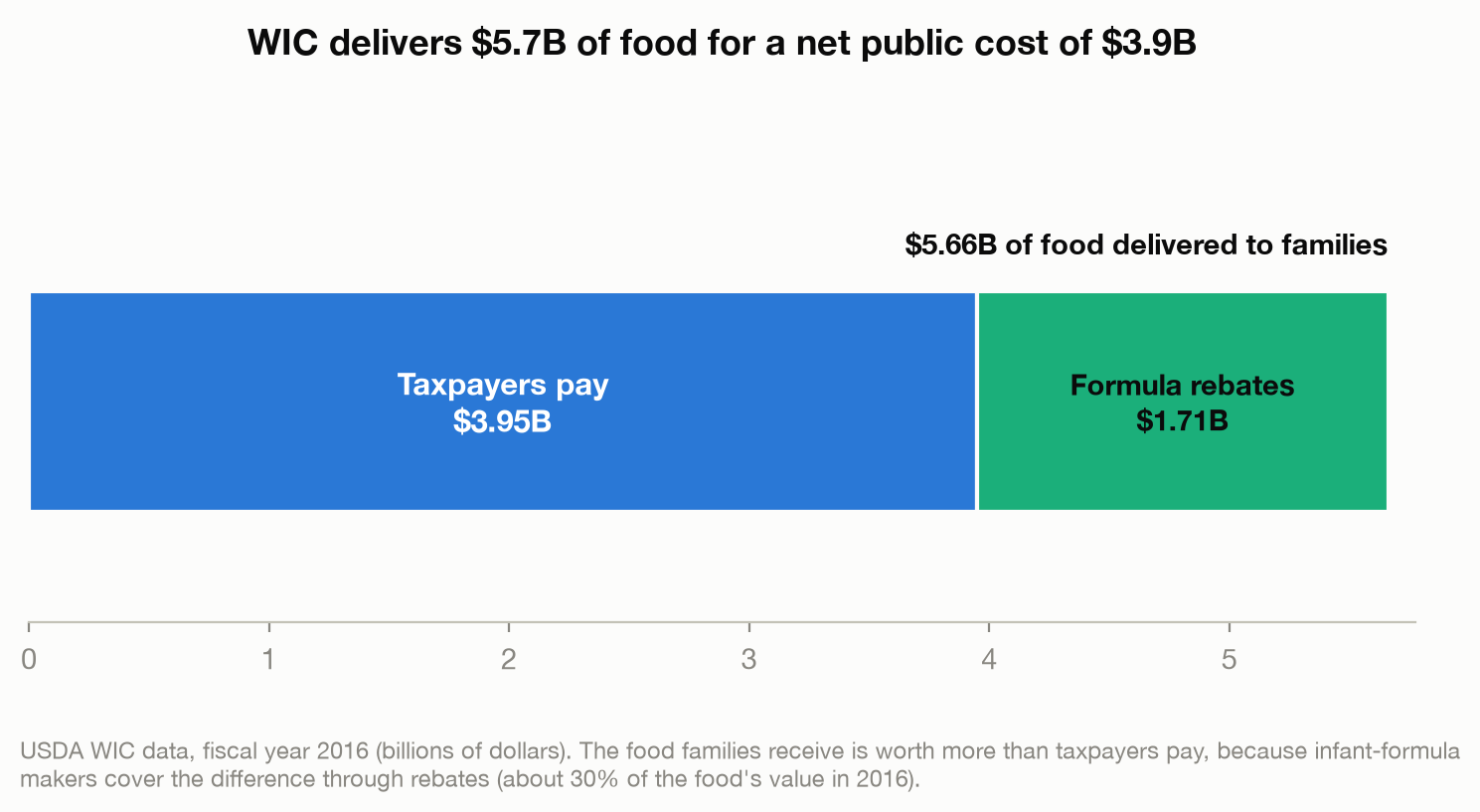
So the food that reached families was worth roughly a third more than the public spent on it. The rebate covered about 30% of the food’s value. A benefit that, on the ledger, looks like a $3.95 billion program is really delivering close to $5.7 billion of groceries.
How a discount becomes a windfall
The mechanism is almost boringly simple, which is why it works. Since 1989, federal law has required each state to hold a competitive bid for infant formula and award a single manufacturer an exclusive contract: whoever offers the deepest discount becomes the only brand of formula that WIC provides in that state (U.S. Department of Agriculture, Food and Nutrition Service, n.d.). Winning means your product is what millions of babies are fed. Losing means being shut out of an entire state for years. So the companies bid enormous discounts.
How enormous? A 2025 federal audit found the rebate was worth about 90% of the manufacturer’s wholesale price in 2023, and had peaked at 124% in 2020, meaning the rebate at times exceeded the wholesale price entirely, and the net cost to WIC was near zero (U.S. Government Accountability Office, 2025). The manufacturer still comes out ahead, because being the WIC brand drives ordinary retail sales too. And the claw-back is durable, not a one-off.
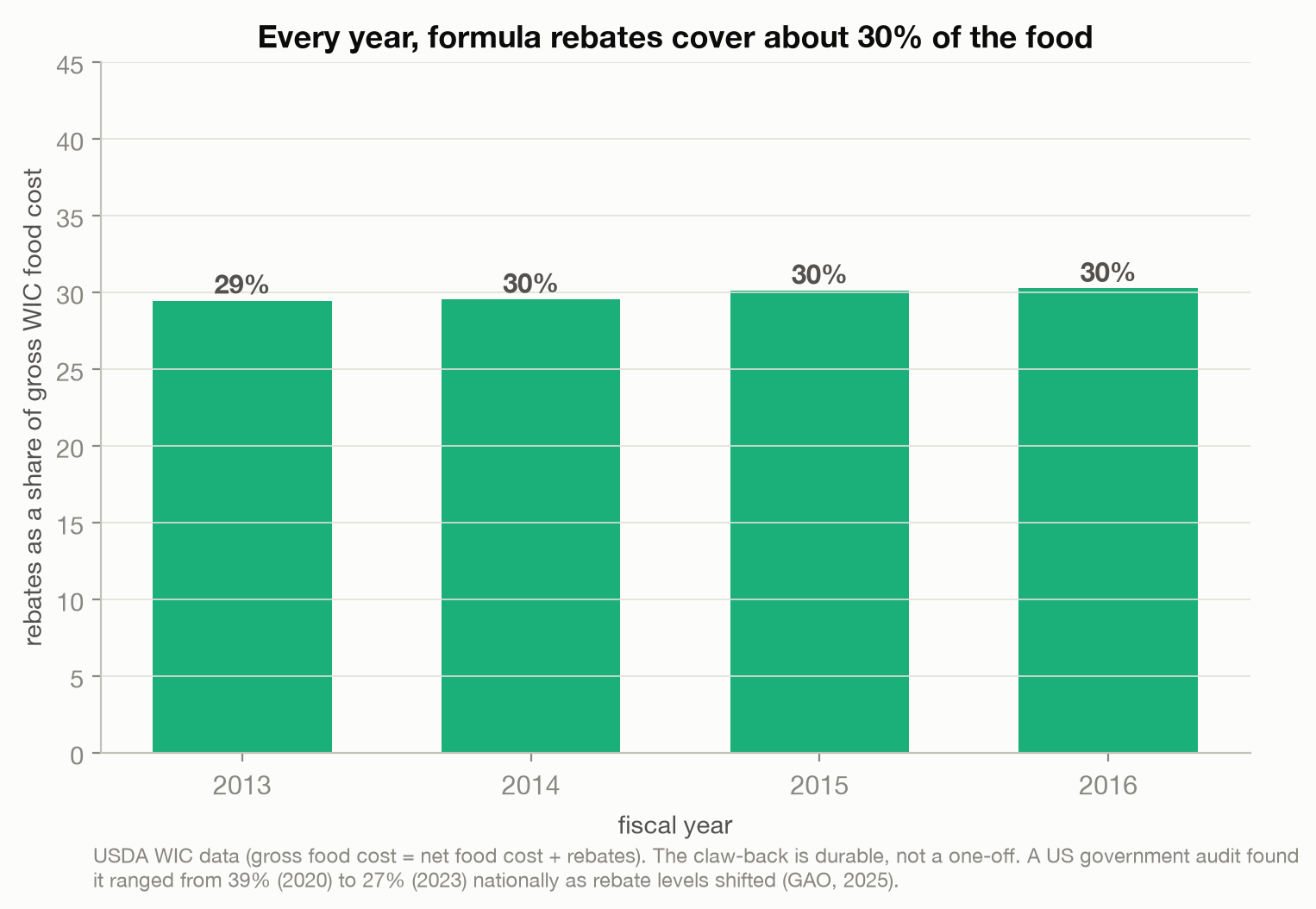
Rebates covered roughly 30% of WIC’s gross food cost every year from 2013 to 2016. The same audit found the national figure ranged from 39% in 2020 down to 27% in 2023 as rebate levels shifted, but the shape is constant: a large, reliable slice of the grocery bill, paid by industry.
What a family actually gets
Turn the national totals into a single participant and the point becomes concrete. In FY2016, WIC provided roughly $61 a month of food per person. The net cost to taxpayers was $42.77 (U.S. Department of Agriculture, Food and Nutrition Service, 2026).
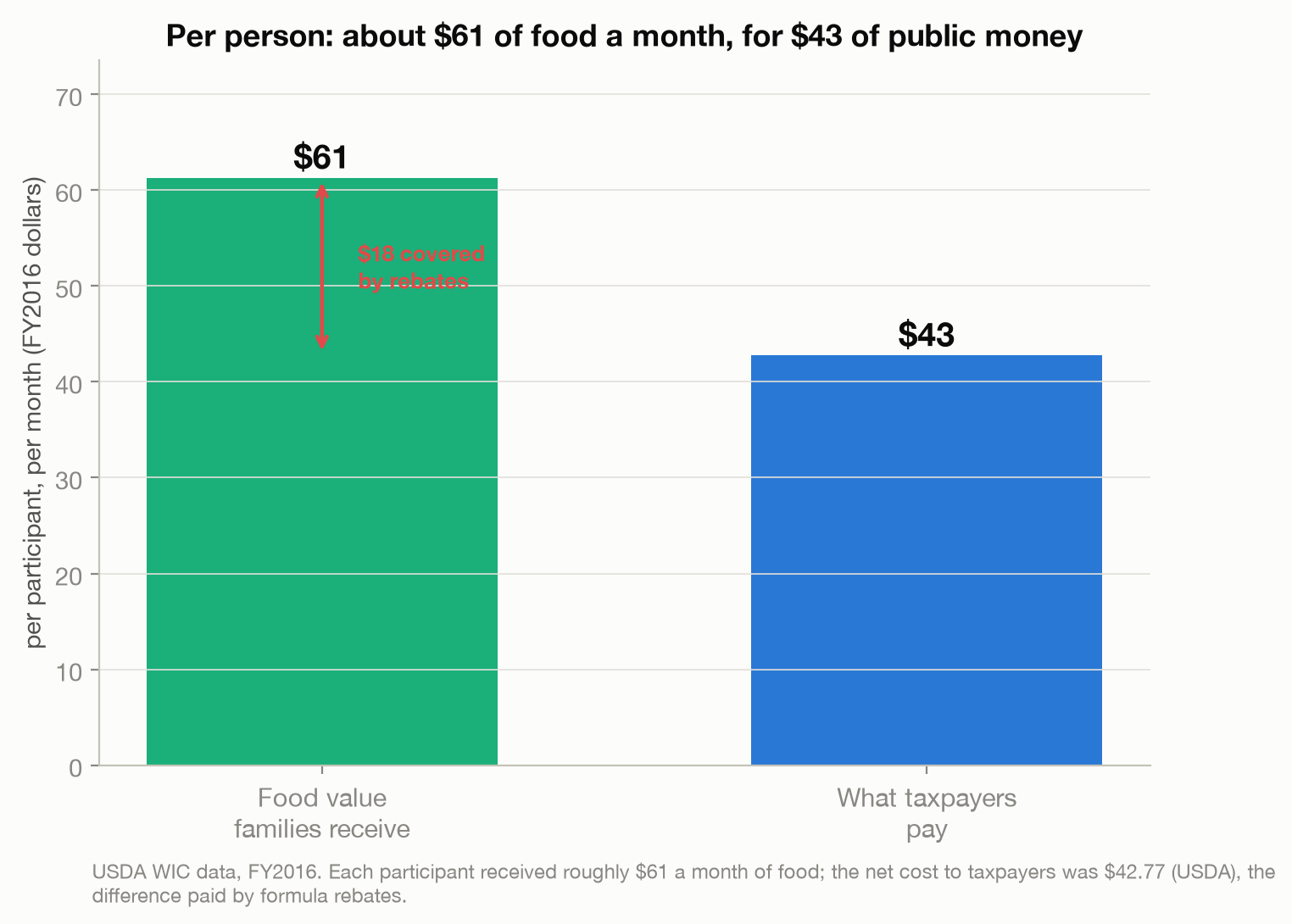
Each participant walks out of the store with about eighteen dollars a month more food than the public paid for. Across 7.7 million people, every month of the year, that gap adds up to the $1.7 billion wedge from the first chart. The benefit is bigger than the budget, person by person.
The engine is formula
None of this would work without one thing: formula. WIC is the largest single purchaser of infant formula in the United States, buying over half of all the formula sold in the country (U.S. Government Accountability Office, 2025). That scale is the lever. A manufacturer will pay almost anything to be the sole brand for half a national market, and that is exactly why the rebates are so large.
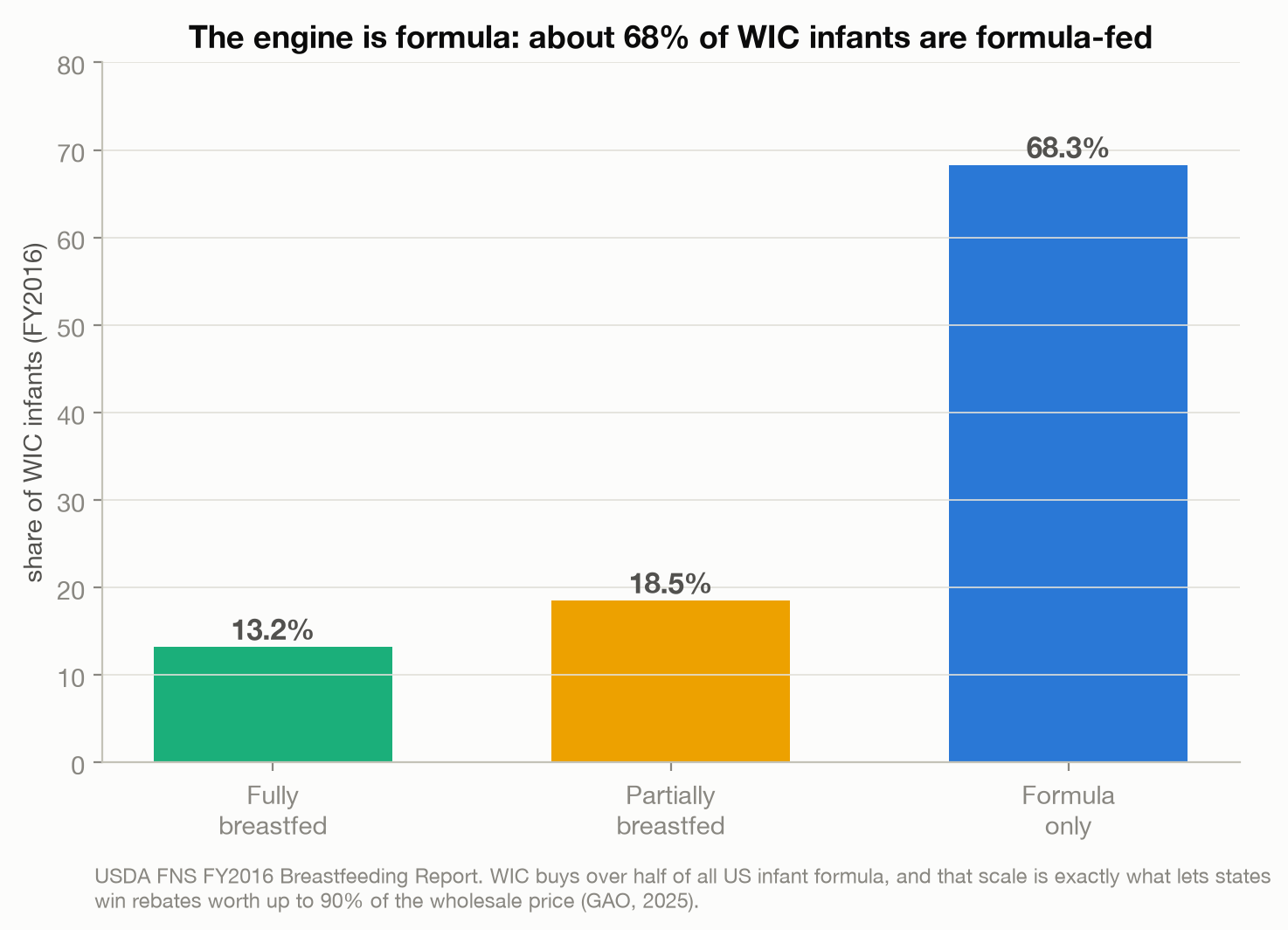
The flip side is visible in the same data. In FY2016, only 13.2% of WIC infants were fully breastfed and 18.5% partially, which means roughly 68% received formula only (U.S. Department of Agriculture, Food and Nutrition Service, 2017). This is the honest nuance. The program most associated with promoting breastfeeding is also the country’s biggest formula buyer, and the efficiency I have been describing runs on that fact. If far more WIC mothers breastfed, families and taxpayers might both be better off, but the rebate machine would shrink. The saving is coupled to the formula.
The design lesson
The transferable idea is not really about formula, or even about the United States. It is about the difference between the sticker price of a benefit and its real cost. When a program buys at enough scale and makes suppliers compete for the whole of it, the suppliers themselves will pay to subsidize part of the public good. The lever is volume plus a single, winner-take-all contract.
That lesson travels. Indonesia launched its own national free-meals program, Makan Bergizi Gratis, in January 2025, aiming to reach 82.9 million people by 2029 (Al Jazeera, 2025). A program at that scale buys staggering volumes of milk, eggs, rice, and other staples. Whether a food benefit ends up costing its full sticker price or a fraction of it depends heavily on whether it is designed, like WIC’s formula contracts, to make its suppliers compete. The economics, not the politics, is the point.
What the ledger hides
It is easy to read a program’s budget line as the measure of what it does. WIC is a small reminder that the line can understate the benefit. Families receive close to $5.7 billion of food; the public pays $3.95 billion; a private industry quietly covers the rest, because someone designed the program so that it would. The benefit costs less than it delivers, on purpose. This is a description of how a mechanism works, not a verdict on the program, and not financial advice.
Method notes
Data: USDA Food and Nutrition Service WIC administrative tables (FY2013-2016), via a Kaggle mirror (jpmiller/publicassistance), plus USDA FNS national data tables and a 2025 GAO audit for verification and current figures. Two reconciliation steps matter and are done throughout: the dataset mixes a “Mountain Plains” regional subtotal row into the state list (dropped, along with blank rows), and its “Food Costs” column is net of rebates, so gross food cost = net + rebates. After both, the cleaned totals match USDA national figures: FY2016 average monthly participation 7.70 million, net food cost $3,949.6 million, rebate savings about $1.72 billion (predominantly infant formula), net food cost per person $42.77. Gross food cost ($5.66B) and per-person gross ($61.30) are derived as net plus rebates; the rebate share of gross is about 30% (2013-2016), consistent with the GAO’s reported national range of 27% (2023) to 39% (2020). The rebate mechanism (single-supplier competitive contracts since 1989; rebate about 90% of the wholesale price for powdered and concentrate formula in 2023, peaking at 124% in 2020; rebates funding roughly one in five participants) is from GAO-25-106503 and USDA FNS. WIC’s “over half of US infant formula” share is from GAO (2025); USDA ERS estimated 57 to 68% for 2004-06 (U.S. Department of Agriculture, Economic Research Service, 2011). Breastfeeding rates are from the USDA FNS FY2016 Breastfeeding Data Local Agency Report. Current context (FY2024: net food cost $4.91B, about $1.6B in rebates, 6.70 million participants) is from USDA FNS. The Indonesia figures are the program operator’s and launch-day reporting; only existence, timing, and scale are used, with no political framing. All figures are descriptive administrative data. The mother at the checkout is an illustrative composite, not a real individual. Code and data are on GitHub: github.com/joechrisnaldy/data-stories.
References
Al Jazeera. (2025, January 6). Indonesia kicks off first free meal programme for children, pregnant women. Al Jazeera. https://www.aljazeera.com/gallery/2025/1/6/indonesia-kicks-off-first-free-meal-programme-for-children-pregnant-women
U.S. Department of Agriculture, Economic Research Service. (2011, September 1). Winner takes (almost) all: How WIC affects the infant formula market. Amber Waves. https://www.ers.usda.gov/amber-waves/2011/september/infant-formula-market
U.S. Department of Agriculture, Food and Nutrition Service. (n.d.). WIC eligibility requirements to bid on state agency infant formula contracts. Retrieved July 19, 2026, from https://www.fns.usda.gov/wic/requirements-infant-formula-contracts
U.S. Department of Agriculture, Food and Nutrition Service. (2017). WIC breastfeeding data local agency report: Fiscal year 2016. U.S. Department of Agriculture.
U.S. Department of Agriculture, Food and Nutrition Service. (2026). WIC program participation and costs [Data tables]. https://www.fns.usda.gov/pd/wic-program
U.S. Government Accountability Office. (2025). WIC infant formula: Single-supplier competitive contracts reduce program costs and modestly increase retail prices (GAO-25-106503). https://www.gao.gov/products/gao-25-106503
// About the author
Jonathan Chrisnaldy is a product manager and analyst in New York City, with an M.S. in Technology Management from Columbia University. He writes data stories about the numbers behind everyday claims. More on the experience page or LinkedIn.