· 23 min read · Jonathan Chrisnaldy
What Should My Family Worry About If MSCI Drops Indonesia?
MSCI has proposed moving Indonesia to Standalone status, and people fear a chain: stocks crash and stay down, the rupiah falls, foreign money leaves, prices rise faster. Against Indonesia's own record, foreign money left Indonesian shares around four of six past shocks, but the index was back above its pre-shock level a year later in four of five; inflation sped up by 2 percentage points or more after one of six rupiah slides, a bank deposit lost buying power after two of six, and consumer-loan rates rose a point or more after one of six.
On 16 October 2026, the IHSG closed 11.57 percent lower, at 5,185 (Indonesia Stock Exchange, 2026), after the index provider MSCI proposed moving Indonesia out of its emerging markets and into a category called Standalone (Reuters, 2026). I read the headlines in New York, and what came to mind was not the index. It was my family in Jakarta: what they pay for groceries, fuel and the basics of daily life, and their rupiah savings for retirement.
The fear runs like a chain. The market crashes and stays down, the rupiah falls, foreign investors leave, and the cost of living rises faster. For a family, the chain does not stop at prices; it reaches savings and the cost of borrowing. I tested each link against Indonesia’s own history. A year after a shock, the index was back above its pre-shock level in four of five cases. Three months after a shock, the rupiah was 5 percent or more weaker in two of six. Foreign investors pulled money out around four of six past shocks. Prices kept rising after six of six sharp falls in the rupiah, but inflation sped up by 2 percentage points or more after one of six. A bank deposit lost buying power after two of six, and the rate on consumer loans rose a percentage point or more after one of six. By my tests, the foreign-money link holds; the other links do not.
This is not financial advice, and it is not a forecast. It is what Indonesia’s own record says about the fears, written for my family and for anyone who felt the same jolt.
What Standalone means, and what it does not
Standalone sounds like a verdict on a country, the kind of label that should sit next to poverty, corruption or war. It is not. MSCI sorts markets by economic development, by the size and liquidity of their shares and by how easily foreign investors can get money in and out, and economic development decides whether a market is Developed, not where the others sit (Baskoro, 2026). Standalone is the category outside the main groups: markets not yet admitted, and markets taken out of the main groups over serious problems with accessibility or with how the market works (Baskoro, 2026).
That is why the company Indonesia might keep looks odd. Euronews lists Jamaica, Panama and Palestine as Standalone markets (Katanich, 2026), and CNN Indonesia (2026) also names Zimbabwe. What these markets share, in MSCI’s terms, is not income.
MSCI’s stated concerns about Indonesia are about who owns the shares and how they trade: a lack of clarity in shareholding structures and suspected coordinated trading (Katanich, 2026). MSCI considered a smaller step down, to frontier status, and set it aside as not reflecting the problems (Reuters, 2026). It is still a proposal: feedback runs until 30 April 2027, and MSCI plans to decide by 30 June 2027 (Desfika & Wijaya, 2026).
How I tested the fear
I used Indonesia’s own history and fixed the rules in a pre-registration on GitHub, with later changes dated. I wrote the first four tests before downloading any data, then changed their data sources and some details after checking the data but before computing any result. I added the savings and borrowing tests after seeing those four results. Their rules were fixed before I read the rate data, but not before I knew the broad outline of Indonesia’s economic history. So before reading that data I wrote down what I expected for each comparison. Twenty-two of the twenty-two predictions I could check came true, so read the savings and borrowing results as confirming what an attentive reader could have guessed, not as discoveries.
Two kinds of events anchor the tests. A shock month is a month whose closing IHSG level is 10 percent or more below the previous month’s close; since 2004, six episodes qualify, starting in August 2005, March 2008, September 2008, March 2020, February 2025 and March 2026. The stock, rupiah and foreign-money tests start from these. A rupiah slide is a month when the rupiah is 7 percent or more weaker against the dollar than three months earlier. The price, savings and borrowing tests start from slides, the route by which a weaker rupiah would reach a family’s costs.
A link holds by my test when two thirds or more of the past episodes meet it, does not hold when a third or fewer do, and is mixed in between. An episode counts for a link only once its outcome is known.
The markets: stocks, the rupiah and foreign money
The fear starts in the markets, so I keep this part short.
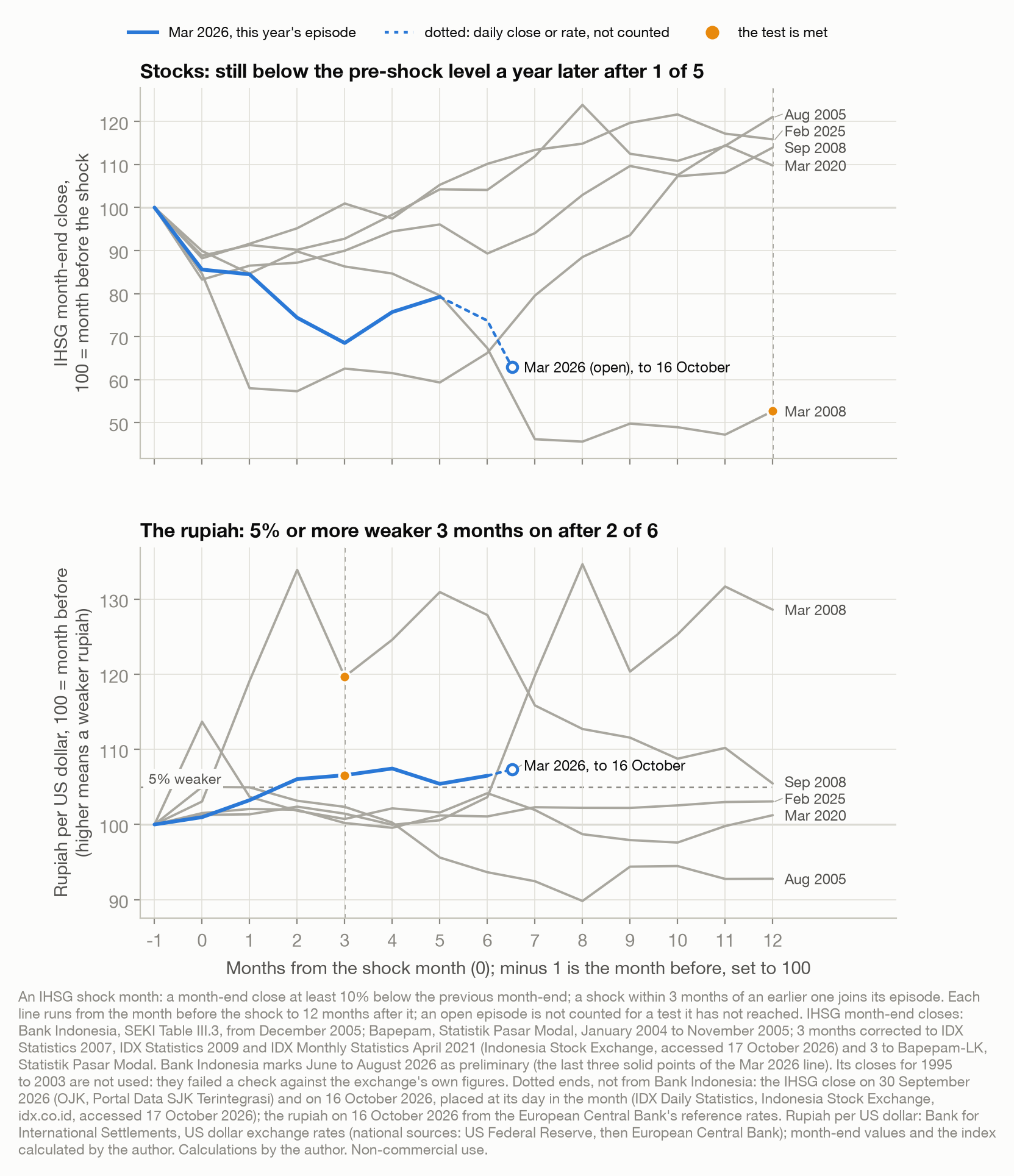
Stocks crash; that is what a shock month is. Staying down is another matter. A year after the shock month, the index was back above its level before the shock in four of five episodes, so this link does not hold by my test. The exception is March 2008: a deeper fall followed that September, and a year on the index was still 47.3 percent below. The episode that began in March 2026 has not reached its year yet. By August 2026, the index stood 20.8 percent below its level before that shock, on Bank Indonesia’s preliminary figures; at the 16 October close, it stood 37.0 percent below. The warning had been building. In January, MSCI froze its index rebalancing for Indonesian shares over concerns about free float (Sigit, 2026), and on 28 January 2026 the IHSG closed 7.35 percent lower.
Three months after the shock month, the rupiah was 5 percent or more weaker against the US dollar in two of six episodes: after September 2008, by 19.7 percent, and after March 2026, by 6.6 percent. This result sits exactly on my line of a third; without this year’s episode it would be one of five.
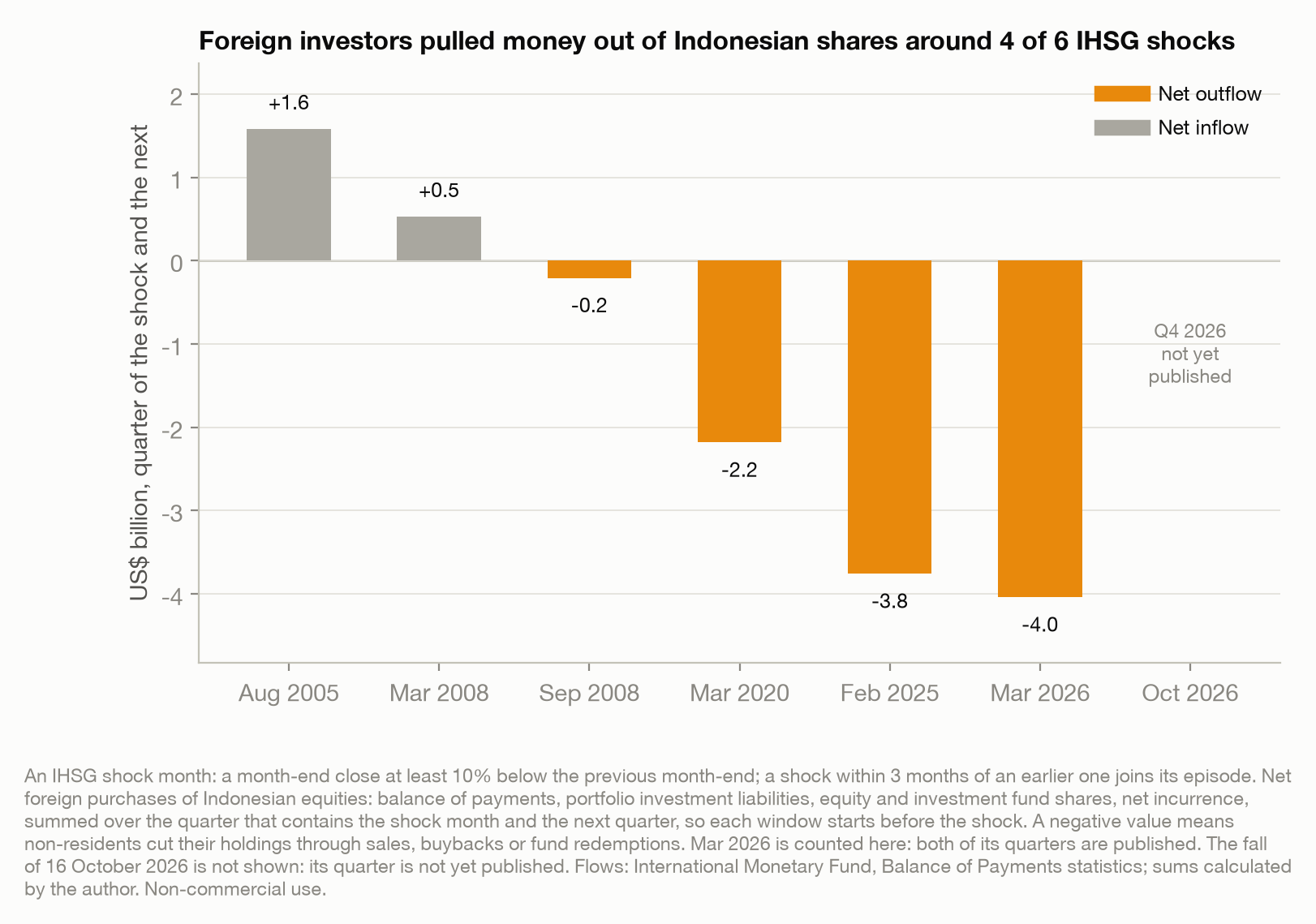
Foreign money is the link that holds. Over the quarter that contains the shock month and the next quarter, foreigners took money out of Indonesian shares in four of six episodes. In the episode that began in March 2026, the outflow came to US$4.0 billion over those quarters, and in the weeks OJK files under January to September 2026, foreign investors sold a net Rp82 trillion of Indonesian shares on the exchange. It holds by a thin margin. Four of six is exactly two thirds, and without this year’s episode it would be three of five, which is mixed.
At the market and the pump
This is the link my family would feel, in groceries, fuel and the basics of daily life. The useful question is not whether prices rise, since they rise in a normal year, but whether a rupiah slide makes them rise faster. Prices kept rising after six of six slides. Inflation sped up by 2 percentage points or more after one of six: after August 2005, when it went from 8.3 percent to 14.9 percent. After the slides of 2008, 2013, 2015 and 2020, prices rose more slowly than in the year before. BPS’s own published rates, as Bank Indonesia reports them (Bank Indonesia, 2026a), differ by as much as 0.8 percentage points from the figures I computed and give the same count.
In October 2005, inside the year after the August slide, the government raised the price of Premium petrol by 87.5 percent and of Solar diesel by 104.8 percent (Presiden Republik Indonesia, 2005). Before the slides of 2008 and 2013, it had raised both fuels by 22 percent or more inside the twelve months my test uses as “before” (Kementerian Energi dan Sumber Daya Mineral, 2014; Menteri Energi dan Sumber Daya Mineral, 2008, 2013). It cut them in the year after the 2008 and 2015 slides (Direktorat Jenderal Minyak dan Gas Bumi, 2016; Menteri Energi dan Sumber Daya Mineral, 2009). Bank Indonesia’s own page on inflation names the fuel price rises of 2005 and 2008 as the source of surges in inflation (Bank Indonesia, n.d.). My test describes this timing; it does not measure how much of any price change came from fuel.
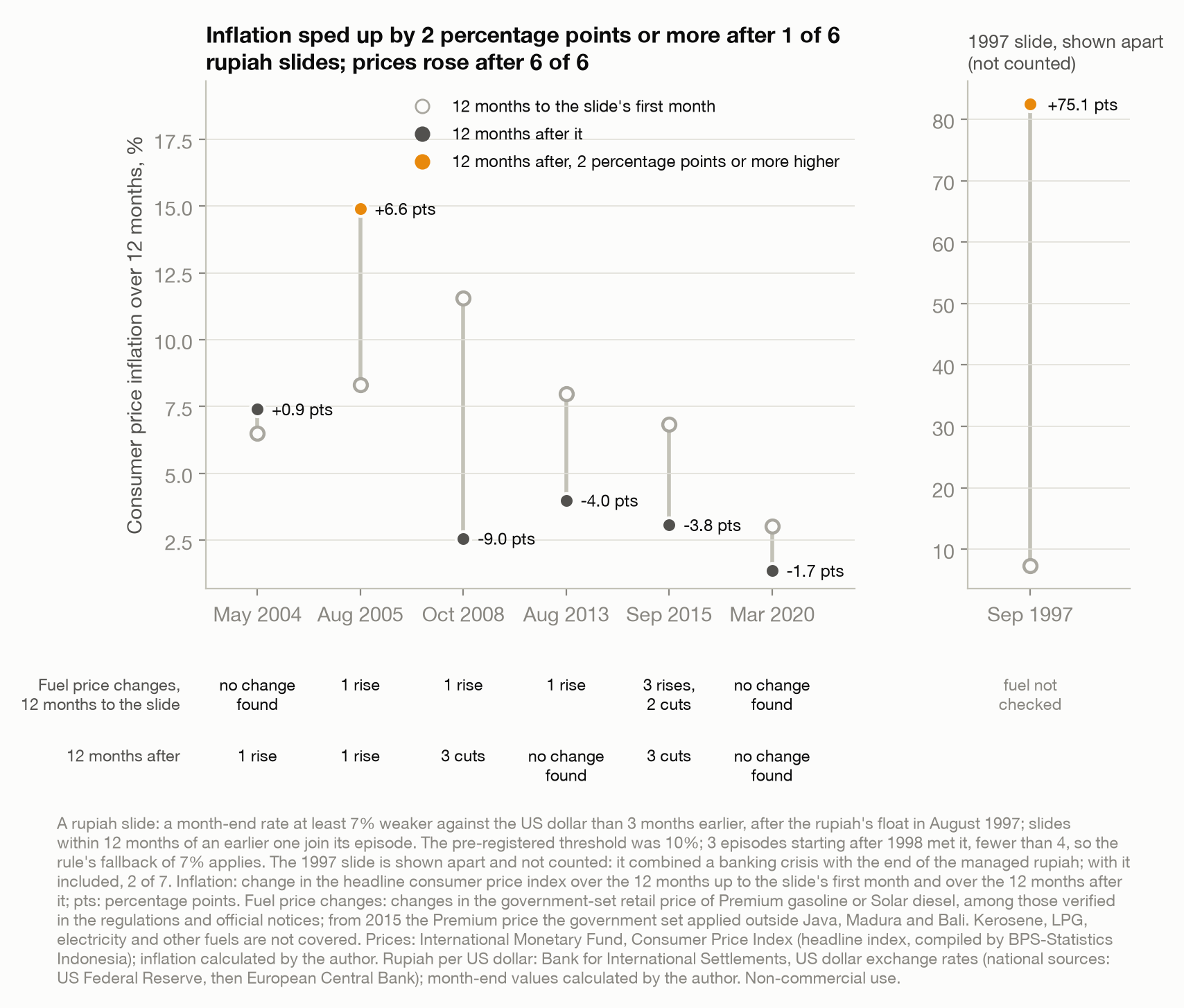
The slide of 1997 is the one people remember, and there inflation went from 7.3 percent to 82.4 percent. As I decided before looking, it is shown apart and left out of the count; with it included, the result is two of seven, which still does not hold.
So far there has been no slide. On 16 October, the rupiah was 0.1 percent stronger against the dollar than at the end of July.
Savings and loans
This section records what a rupiah bank deposit earned against prices after past slides. It does not say where anyone should keep their savings, and it is not financial advice.
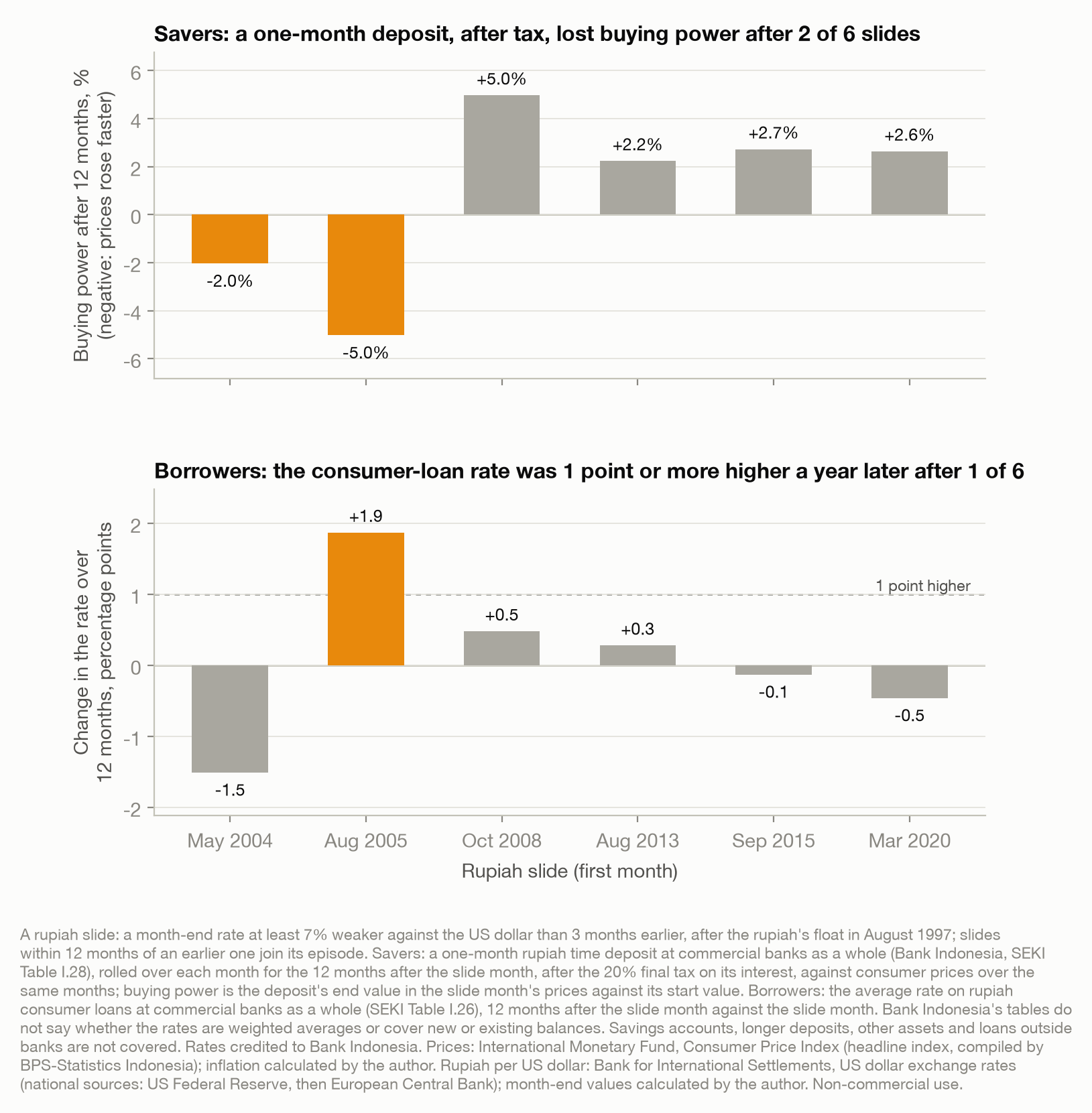
My family’s retirement savings are in rupiah, so the question I care about is whether a slide eats into their buying power. A bank time deposit is a plain rupiah saving with a published rate, so I tested a hypothetical one: a one-month deposit at the average rate of Indonesia’s commercial banks (Bank Indonesia, 2026b), rolled over each month for the twelve months after the slide, after the 20 percent final tax on its interest (Pemerintah Republik Indonesia, 2000), against prices over the same months.
The deposit lost buying power after two of six slides, after May 2004 and August 2005, so this link does not hold by my test, though two of six sits exactly on my line of a third. Across the 261 twelve-month periods starting from January 2004, the same deposit lost buying power in 34 percent. After the 1997 slide, under the tax then in force, the deposit lost 23.3 percent of its buying power; with 1997 included, the count is three of seven, which is mixed.
For anyone with a bank loan, the question is the rate. The average rate banks charged on consumer loans (Bank Indonesia, 2026b) was a percentage point or more higher a year after the slide in one of six cases: after August 2005, by 1.9 points. Bank Indonesia’s policy rate (for May 2004, the one-month SBI rate) rose by 0.25 percentage points or more in the slide month or the three months after in two of the five slides I could check, after 2008 and 2013; for 2005, I could not find its rate for July. A fixed-rate loan does not move at all, and loans from finance companies and pawnshops are not in these figures.
What I would tell my family
Here is the scorecard, by my tests:
| The fear | My test | Result | By my test |
|---|---|---|---|
| Stocks crash and stay down | Still below the pre-shock level a year later | One of five | Does not hold |
| The rupiah falls | 5 percent or more weaker three months on | Two of six | Does not hold |
| Foreign investors leave | Net outflow over the shock’s quarter and the next | Four of six | Holds |
| Inflation speeds up | 2 points or more faster over the year after a slide | One of six | Does not hold |
| Savings lose buying power | A deposit, after tax, behind prices | Two of six | Does not hold |
| Borrowing gets dearer | Consumer-loan rate a point or more higher a year on | One of six | Does not hold |
So my message home would be this. The stock market can keep falling, and foreign money is already leaving Indonesian shares. Faster inflation, a deposit’s lost buying power and consumer-loan rates a point or more higher followed past slides in a minority of cases, and the rupiah has not slid so far. The thing to watch at home is not the index. It is the price of fuel. Before MSCI decides, I would also watch whether the concerns it raised, about who owns the shares and how they trade, are addressed, and whether the rupiah makes a slide by the rule above.
The limits of this test
- The samples are small: five or six episodes per link. For stocks, the rupiah, foreign money and savings, a different outcome in one episode would change the verdict. Read with the pivot a month earlier, inflation sped up after two of six slides, exactly on my line, which still does not hold.
- No past episode here was an MSCI downgrade. This compares the falls Indonesia has had with the fall it is having, not downgrades with downgrades.
- The stock series starts in 2004. Bank Indonesia’s earlier month-end figures failed a check against the exchange’s own records, so the 1997 crash is in the price and savings tests but not in the stock tests.
- March 2008 barely counts as a shock: the index fell 10.1 percent that month, against a threshold of 10 percent.
- The slide rule has another reading. Read as I fixed it, slides in the few years that followed join the 1997 episode; cut at the end of that crisis instead, the inflation link does not hold.
- Food prices are not tested: no consistent food price series runs back far enough. Fuel is described, not tested, and covers the pump prices of Premium and Solar, not other fuels; from 2015 the Premium price the government set applied outside Java, Madura and Bali.
- The savings test uses a one-month bank deposit. Savings accounts, longer deposits, gold and pensions are not covered, small balances that escape the tax are not modelled, and a year says little about savings held for decades.
Method notes and credits
The rules, data checks and code are in the post’s folder on GitHub, including the pre-registration, its dated amendments and the predictions. Shock months use the IHSG’s month-end close: Bank Indonesia’s statistics table III.3 from December 2005 (Bank Indonesia, 2026c), Bapepam’s capital market statistics before that (Badan Pengawas Pasar Modal, 2005), and six months corrected to the Indonesia Stock Exchange’s own figures (Indonesia Stock Exchange, 2007, 2009, 2021) or Bapepam-LK’s (Badan Pengawas Pasar Modal dan Lembaga Keuangan, 2007). Each month from December 2005 was checked against an independent publication. The rupiah is the daily US dollar rate from the Bank for International Settlements (2026), with the European Central Bank’s reference rates (European Central Bank, 2026) used for the last few days, computed by me. Foreign money is the International Monetary Fund’s balance of payments: portfolio investment in Indonesian equity, net, in US dollars (International Monetary Fund, 2026a). Prices are the International Monetary Fund’s headline consumer price index for Indonesia, compiled by BPS-Statistics Indonesia (International Monetary Fund, 2026b), set beside BPS’s published rates from Bank Indonesia’s inflation data (Bank Indonesia, 2026a). Deposit, loan and policy rates are Bank Indonesia’s statistics tables I.28 and I.26, for commercial banks as a whole, and I.25.A (Bank Indonesia, 2026b); each was checked against an earlier edition of the same table. Fuel price changes come from government regulations and official notices, each stored and checked by script. Changes, returns, sums and inflation rates are my calculations. The October figures for the index come from the Indonesia Stock Exchange’s daily statistics (Indonesia Stock Exchange, 2026), the January fall from OJK’s data portal (Otoritas Jasa Keuangan, 2026a), and the foreign selling on the exchange from the same portal (Otoritas Jasa Keuangan, 2026b).
Credits: Bank Indonesia (as its data policy requires: Bank Indonesia, 2024), Bapepam and Bapepam-LK, the Indonesia Stock Exchange, OJK, BPS-Statistics Indonesia, the Ministry of Energy and Mineral Resources and Pertamina, the Bank for International Settlements, the US Federal Reserve, the European Central Bank and the International Monetary Fund. This post is not endorsed by any of them, and its use of their data is non-commercial. MSCI’s own documents were not used; its announcement is reported here from the press.
References
Badan Pengawas Pasar Modal. (2005). Statistik pasar modal [Capital market statistics], weekly issue to 2 December 2005, Table 8. Internet Archive copy of the OJK archive file. https://web.archive.org/web/20170630073004id_/http://www.ojk.go.id/id/kanal/pasar-modal/data-dan-statistik/statistik-pasar-modal/Documents/408.pdf
Badan Pengawas Pasar Modal dan Lembaga Keuangan. (2007). Statistik pasar modal [Capital market statistics], weekly issue for week I of March 2007, Table 8. Internet Archive copy of the Bapepam-LK file. https://web.archive.org/web/20070322170355id_/http://www.bapepam.go.id:80/pasar_modal/publikasi_pm/statistik_pm/2007/2007_III_1.pdf
Bank for International Settlements. (2026). US dollar exchange rates [Data set]. Retrieved October 16, 2026, from https://data.bis.org/topics/XRU
Bank Indonesia. (n.d.). Inflasi [Inflation]. Retrieved October 17, 2026, from https://www.bi.go.id/id/fungsi-utama/moneter/inflasi/default.aspx
Bank Indonesia. (2024). Peraturan Bank Indonesia Nomor 12 Tahun 2024 tentang kebijakan data dan informasi Bank Indonesia [Bank Indonesia Regulation on its data and information policy]. https://www.bi.go.id/id/publikasi/peraturan/Pages/PBI_122024.aspx
Bank Indonesia. (2026a). Data inflasi [Inflation data] [Data set]. Retrieved October 17, 2026, from https://www.bi.go.id/id/statistik/indikator/data-inflasi.aspx
Bank Indonesia. (2026b). Statistik ekonomi dan keuangan Indonesia: Suku bunga [Indonesian economic and financial statistics: Interest rates] (Tables I.25.A, I.26 and I.28) [Data set]. Retrieved October 17, 2026, from https://www.bi.go.id/id/statistik/ekonomi-keuangan/seki/Default.aspx
Bank Indonesia. (2026c). Statistik ekonomi dan keuangan Indonesia: Transaksi dan indeks harga saham di Bursa Efek Indonesia [Indonesian economic and financial statistics: Transaction and stock price indices at the Indonesia Stock Exchange] [Data set]. Retrieved October 16, 2026, from https://www.bi.go.id/id/statistik/ekonomi-keuangan/seki/Default.aspx
Baskoro, F. M. (2026, October 16). Explainer: What is MSCI market classification and why does it matter for Indonesia? Jakarta Globe. https://jakartaglobe.id/business/explainer-what-is-msci-market-classification-and-why-does-it-matter-for-indonesia
CNN Indonesia. (2026, October 16). Apa itu standalone market di tengah riuh pengumuman MSCI? [What is a standalone market amid the uproar over MSCI’s announcement?]. https://www.cnnindonesia.com/ekonomi/20261016085631-92-1415988/apa-itu-standalone-market-di-tengah-riuh-pengumuman-msci
Desfika, T. S., & Wijaya, R. F. (2026, October 16). Indonesia could join Zimbabwe, Palestine in MSCI standalone market downgrade. Jakarta Globe. https://jakartaglobe.id/business/indonesia-could-join-zimbabwe-palestine-in-msci-standalone-market-downgrade
Direktorat Jenderal Minyak dan Gas Bumi. (2016, March 30). Siaran pers: Penetapan harga BBM berlaku 1 April 2016 [Press release: Fuel prices from 1 April 2016]. https://migas.esdm.go.id/post/siaran-pers---penetapan-harga-bbm-berlaku-1-april-2016
European Central Bank. (2026). Euro foreign exchange reference rates [Data set]. Retrieved October 16, 2026, from https://www.ecb.europa.eu/stats/policy_and_exchange_rates/euro_reference_exchange_rates/html/index.en.html
Indonesia Stock Exchange. (2007). IDX statistics 2007. Internet Archive copy of the IDX file. Retrieved October 17, 2026, from https://web.archive.org/web/20110125080940id_/http://www.idx.co.id:80/Portals/0/StaticData/Publication/Statistic/Yearly/IDX%20STATISTICS%202007.pdf
Indonesia Stock Exchange. (2009). IDX statistics 2009. Internet Archive copy of the IDX file. Retrieved October 17, 2026, from https://web.archive.org/web/20110817005635id_/http://www.idx.co.id/Portals/0/StaticData/Publication/Statistic/Yearly/IDX%20STATISTICS%202009_revisi.pdf
Indonesia Stock Exchange. (2021). IDX monthly statistics, April 2021. Internet Archive copy of the IDX file. Retrieved October 17, 2026, from https://web.archive.org/web/20210518045642id_/https://www.idx.co.id/media/9881/idx-monthly-apr-2021.pdf
Indonesia Stock Exchange. (2026). IDX daily statistics [Reports for 15 and 16 October 2026]. Retrieved October 17, 2026, from https://www.idx.co.id/Media/bfsctwrv/ds_261015.pdf and https://www.idx.co.id/Media/bndpqsus/ds_261016.pdf
International Monetary Fund. (2026a). Balance of payments (BOP) [Data set]. Retrieved October 16, 2026, from https://api.imf.org/external/sdmx/2.1/data/IMF.STA,BOP,21.0.0/IDN.L_NIL_T.P_F5.USD.Q
International Monetary Fund. (2026b). Consumer price index (CPI) [Data set]. Retrieved October 16, 2026, from https://data.imf.org/en/datasets/IMF.STA:CPI
Katanich, D. (2026, October 16). Indonesian stocks plunge 11% as MSCI proposes emerging market downgrade. Euronews. https://www.euronews.com/2026/10/16/indonesian-stocks-plunge-11-as-msci-proposes-emerging-market-downgrade
Kementerian Energi dan Sumber Daya Mineral. (2014, November 17). Penyesuaian harga bahan bakar minyak (BBM) bersubsidi [Adjustment of subsidised fuel prices] [Press release No. 60/SJI/2014]. https://www.esdm.go.id/id/media-center/arsip-berita/penyesuaian-harga-bahan-bakar-minyak-bbm-bersubsidi
Menteri Energi dan Sumber Daya Mineral. (2008). Peraturan Menteri Energi dan Sumber Daya Mineral tentang harga jual eceran bahan bakar minyak jenis minyak tanah (kerosene), bensin premium dan minyak solar (gas oil) untuk keperluan rumah tangga, usaha kecil, usaha perikanan, transportasi dan pelayanan umum [Regulation No. 16 of 2008 on the retail prices of kerosene, Premium gasoline and diesel] [Abstract]. Jaringan Dokumentasi Informasi Hukum, Kementerian ESDM. Internet Archive copy. https://web.archive.org/web/20170503031650id_/http://jdih.esdm.go.id:80/view/abstrak.php?id=633
Menteri Energi dan Sumber Daya Mineral. (2009). Peraturan Menteri Energi dan Sumber Daya Mineral tentang harga jual eceran bahan bakar minyak jenis minyak tanah (kerosene), bensin premium dan minyak solar (gas oil) untuk keperluan rumah tangga, usaha kecil, usaha perikanan, transportasi, dan pelayanan umum [Regulation No. 1 of 2009 on the retail prices of kerosene, Premium gasoline and diesel] [Abstract]. Jaringan Dokumentasi Informasi Hukum, Kementerian ESDM. Internet Archive copy. https://web.archive.org/web/20170503055604id_/http://jdih.esdm.go.id:80/view/abstrak.php?id=659
Menteri Energi dan Sumber Daya Mineral. (2013). Peraturan Menteri Energi dan Sumber Daya Mineral Republik Indonesia Nomor 18 Tahun 2013 tentang harga jual eceran jenis bahan bakar minyak tertentu untuk konsumen pengguna tertentu [Regulation on the retail prices of certain fuels for certain users]. Internet Archive copy of the JDIH ESDM file. https://web.archive.org/web/20220723081651/https://jdih.esdm.go.id/storage/document/Permen%20ESDM%2018%202013.pdf
Otoritas Jasa Keuangan. (2026a). Indeks dan kapitalisasi pasar [Index and market capitalisation] [Data set]. Portal Data SJK Terintegrasi. Retrieved October 16, 2026, from https://data.ojk.go.id/SJKPublic/Dataset/Dataset/Dataset/274
Otoritas Jasa Keuangan. (2026b). Nilai perdagangan saham di bursa [Value of share trading on the exchange] [Data set]. Portal Data SJK Terintegrasi. Retrieved October 16, 2026, from https://data.ojk.go.id/SJKPublic/Dataset/Dataset/Dataset/404
Pemerintah Republik Indonesia. (2000). Peraturan Pemerintah Republik Indonesia Nomor 131 Tahun 2000 tentang pajak penghasilan atas bunga deposito dan tabungan serta diskonto Sertifikat Bank Indonesia [Government Regulation on income tax on deposit and savings interest and Bank Indonesia Certificate discounts]. https://peraturan.bpk.go.id/Download/43363/PP%20No.131%20TH%202000.pdf
Presiden Republik Indonesia. (2005). Peraturan Presiden Republik Indonesia Nomor 55 Tahun 2005 tentang harga jual eceran bahan bakar minyak dalam negeri [Presidential Regulation on domestic fuel retail prices]. https://peraturan.bpk.go.id/Download/73247/PERPRES%20NO%2055%20TH%202005.pdf
Reuters. (2026, October 16). MSCI weighs downgrading Indonesia to standalone-market status. The Jakarta Post. https://www.thejakartapost.com/business/2026/10/16/msci-weighs-downgrading-indonesia-to-standalone-market-status
Sigit, B. (2026, January 28). MSCI bekukan rebalancing, saham Indonesia masuk interim freeze [MSCI freezes rebalancing; Indonesian shares enter an interim freeze]. Fortune Indonesia. https://www.fortuneidn.com/market/msci-bekukan-rebalancing-saham-indonesia-masuk-interim-freeze-d7w03-00-dz73p-hrlsxj
// About the author
Jonathan Chrisnaldy is a product manager and analyst in New York City, with an M.S. in Technology Management from Columbia University. He writes data stories about the numbers behind everyday claims. More on the experience page or LinkedIn.