· 9 min read · Jonathan Chrisnaldy
The Most Generous Country on Earth Isn't the Happiest
No country on earth gives more than Indonesia, and few feel more daily joy, yet it ranks about 80th on the world happiness ladder. That gap is the whole story: how you rate your life and how you feel living it are two different questions, and the famous ranking only measures one of them.
Picture an Indonesian woman on a good ordinary day. She spends the afternoon laughing with friends, shares food she cannot quite afford, gives a little to the mosque collection, and goes to bed content. Then a surveyor asks her the one question the world happiness ranking rests on: think of a ladder, the best possible life for you is a 10 and the worst is a 0; where do you stand today? She thinks about the traffic, the salary, the price of rice, the future, and she says: a six.
Both answers are honest. The laughter was real and the six was real. They are answers to two different questions, and almost everything interesting about happiness lives in the space between them. Indonesia is the clearest case on earth, because it is near the top of the world for the first kind of happiness and squarely in the middle for the second.
Two kinds of happiness
The World Happiness Report’s famous ranking is built on that ladder question. It is a life evaluation: stop, think about your life as a whole, and rate it. Psychologists have long separated that from a second kind of well-being, the emotional texture of your actual days, the joy and laughter and worry you feel as you live them (Kahneman & Deaton, 2010). The survey measures that too, as “positive affect”, but it is not what the headline ranking reports.
When you plot one against the other, they only loosely agree.
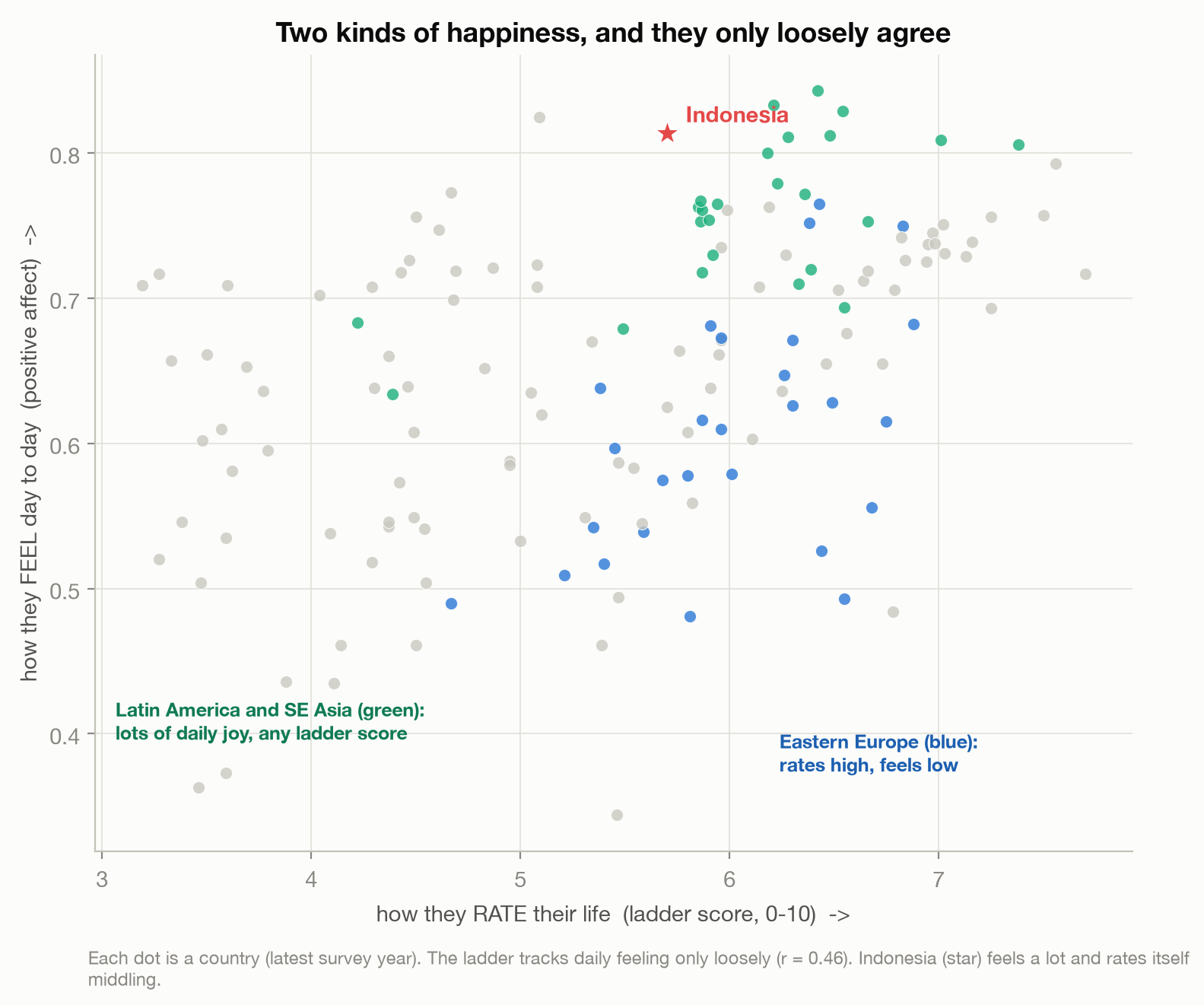
The correlation between rating your life and feeling good day to day is just 0.46 across countries. Two groups pull away from the crowd. Latin America and Southeast Asia sit high on daily feeling almost regardless of where they land on the ladder: Guatemala, Paraguay, Panama, Costa Rica, and Mexico, along with Indonesia, Thailand, and the Philippines, all report more everyday joy than much richer places. And a band of Eastern European countries do the opposite, rating their lives well up the ladder while reporting some of the lowest daily positive emotion in the world: Poland, Serbia, Lithuania, Slovenia. Indonesia is the red star, high on feeling, a six on the ladder.
Indonesia gives the most
Now the fact that started me on this. On the report’s generosity measure, Indonesia is not near the top. It is the top, first of about 150 countries.
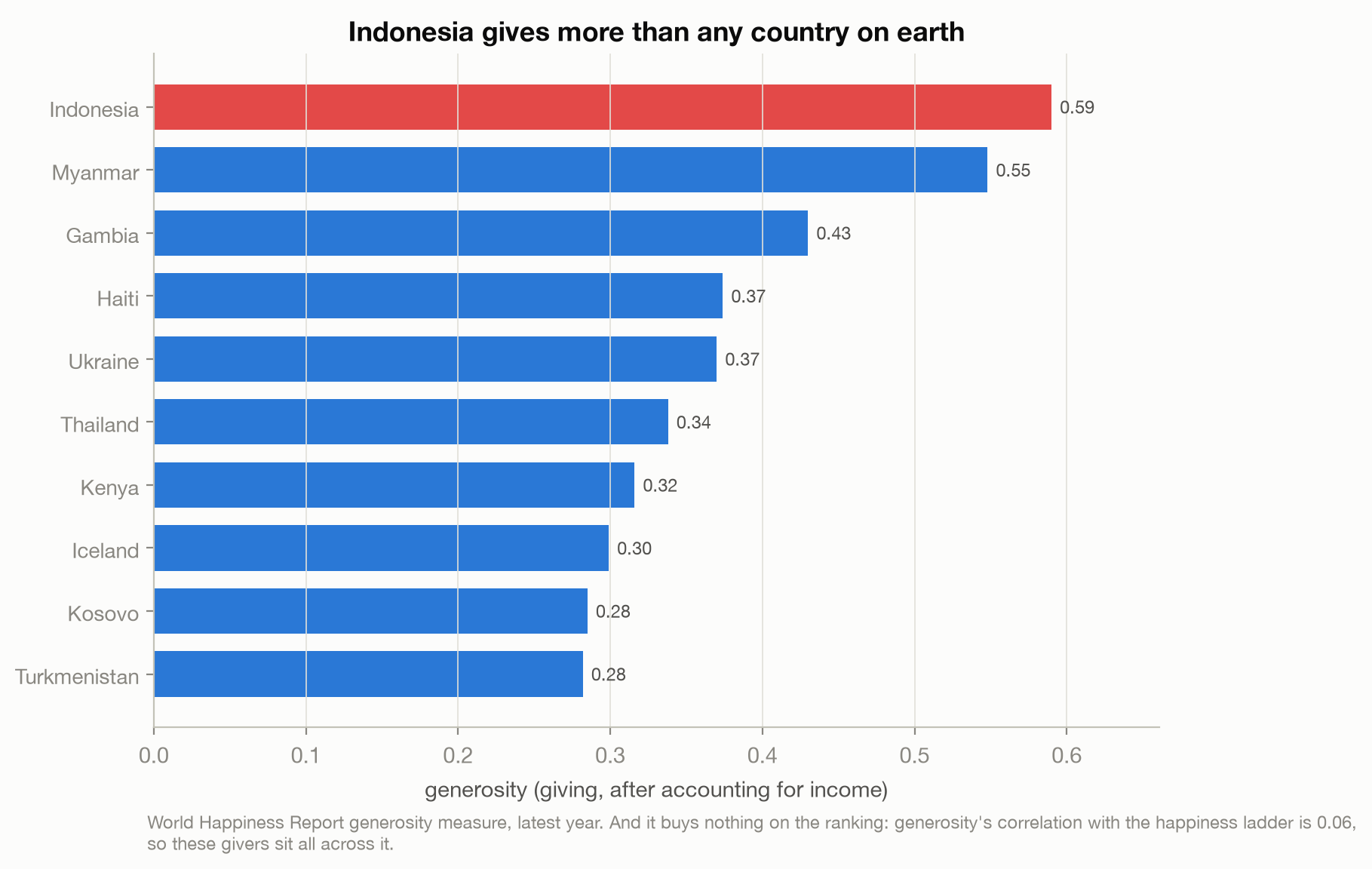
That measure is not just raw donations, which would only tell you who is rich. It is how likely people are to have given to charity in the past month, after you account for how wealthy their country is. By that measure Indonesians give more than anyone. A separate survey agrees: the Charities Aid Foundation’s World Giving Index has ranked Indonesia the most generous country in the world in its 2018, 2021, 2022, and 2023 editions (Charities Aid Foundation, 2023).
Here is the part that should stop you. That world-leading generosity does almost nothing for Indonesia’s place on the happiness ladder. Across countries, generosity’s correlation with the ladder is 0.06, which is to say none at all. The most generous countries scatter clear across the ranking: Myanmar, Gambia and Haiti near the bottom, Iceland and Thailand near the top. Giving simply is not something the happiness ladder tracks. What it tracks most tightly is income and social support, both at correlations near 0.78 and 0.79. Daily joy, the other thing Indonesia has in abundance, tracks it only loosely, the same 0.46 we started with. So a country can lead the world in giving and everyday joy, as Indonesia does, and still land in the middle of a ladder that runs mostly on income and social support.
The texture behind the number
The data can show the what. It cannot prove the why, and I will not pretend otherwise. But the shape of Indonesian giving is not mysterious to anyone who has lived there. There is zakat, the Islamic obligation to give a share of your wealth to those with less. There is gotong royong, the old habit of shouldering a task together, the neighbours who show up when a house needs rebuilding or a wedding needs paying for. Giving in Indonesia is less a private virtue than a daily social reflex, closer to how you breathe than to how you budget. That it comes with a lot of everyday laughter, and not with a high score on a ladder that runs on income, tells you more about the ladder than about Indonesia.
Feeling high, judging middling
You can see the whole paradox in one picture: where a country ranks on daily feeling versus where it ranks on rating its life.
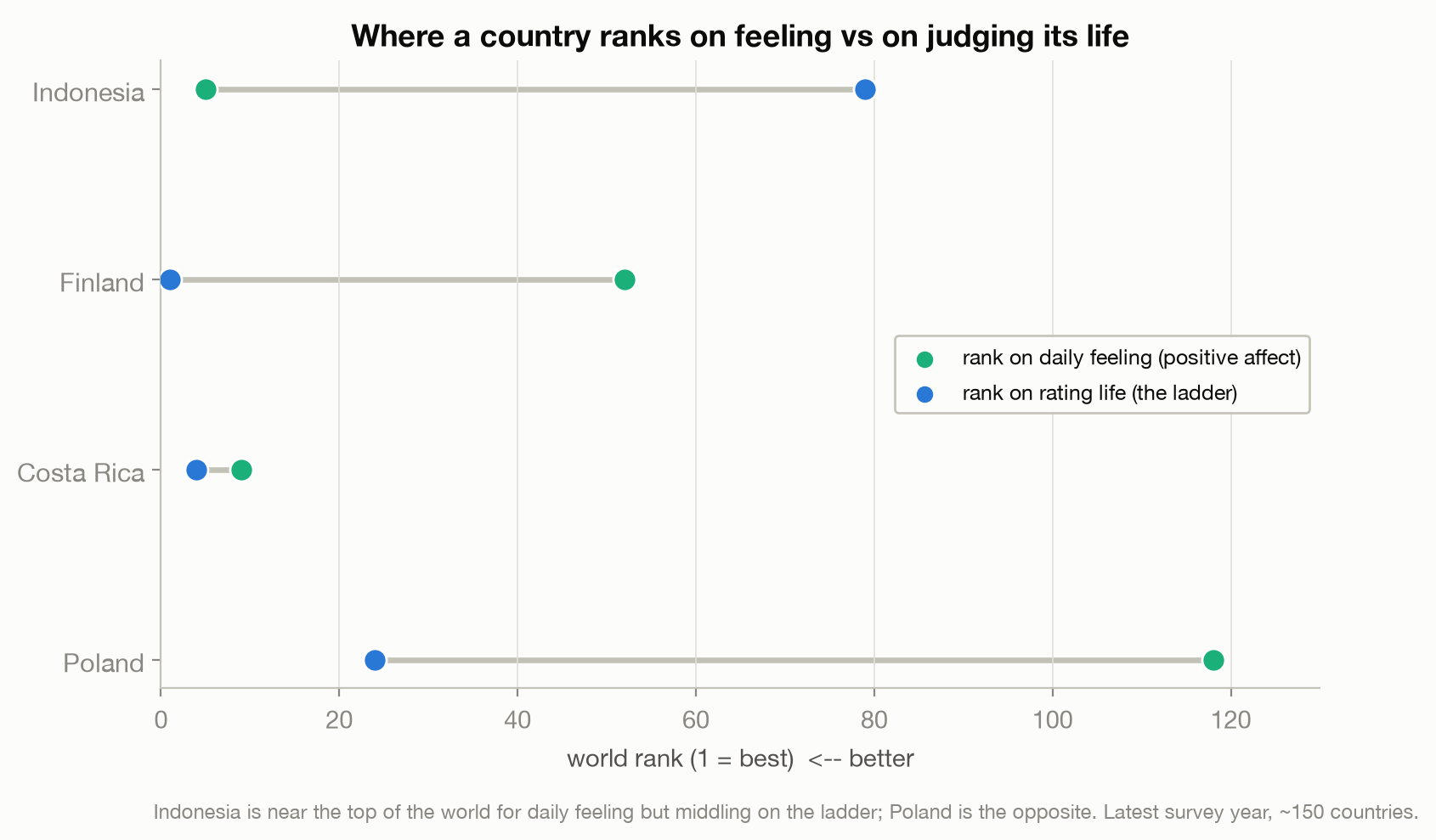
Indonesia is fifth in the world for daily positive emotion and about eightieth for how it rates its life. Finland, which tops the happiness ranking, is the quiet opposite: first on the ladder, only about fiftieth for daily feeling, a country that judges its life excellent without necessarily bubbling over with joy. Poland rates its life comfortably up the ladder and sits near the bottom of the world for everyday positive emotion. Costa Rica is the rare country that manages both. None of these countries is lying on either measure. They are just answering different questions, and the ranking we all quote only listens to one of the answers.
To be fair to the ladder: it is not wrong, and the things it tracks are real. The lives people rate highest tend to have income and someone to count on, and Indonesia, middling on both, rates its life middling. That is honest too. The mistake is not the ranking. The mistake is reading it as the last word on who is happy.
Which happiness are you keeping score of
This is not really about countries. It is about you.
You also have two happinesses, and they can diverge just as far. There is the life you would describe if someone asked you to rate it, the one that runs on salary and title and the shape of your five-year plan. And there is the one you actually inhabit on a Tuesday afternoon, made of who you had lunch with and whether you laughed. A promotion can lift the first and do nothing for the second. An afternoon like hers can be the reverse. When people chase “happiness”, they are usually chasing the ladder, because it is the one with a number on it, and numbers are easy to keep score of. The daily one has no ranking, so it is easy to stop noticing.
Indonesia’s quiet lesson is that you can be near the top of the world on the happiness that has no scoreboard while sitting in the middle of the one that does, and that giving a lot buys you plenty of the first and none of the second. Before you decide which country, or which life, is the happy one, it is worth asking which happiness you have been keeping score of, and whether it is the one you would actually want to win.
Method notes
Data: the World Happiness Report 2024 (Helliwell, Layard, Sachs, De Neve, Aknin, & Wang, Eds.), via a Kaggle re-upload (Jaina, 2024). Two files: the 2024 cross-section of 143 countries, used for the official ladder ranking (Indonesia scores 5.57, about 80th), and the 2005-2024 panel, used at its latest year per country (about 150 countries) for the raw factor values and for positive affect. Both read as latin-1. “Ladder score” is the Cantril life-evaluation (rate your life 0 to 10). “Generosity” is the report’s residual of the charity-donation question regressed on log GDP per capita, so it is giving adjusted for national income, not raw dollars; Indonesia ranks first on it. Correlations, all Pearson across the latest-year countries: generosity with the ladder 0.06, positive affect with the ladder 0.46, social support with the ladder 0.79; log GDP alone explains about 62 percent of the ladder’s variance (its correlation with the ladder is about 0.78). World ranks for the dumbbell chart are within the latest-year panel. Everything here is descriptive and associational: these are correlations, not causes, and the cultural notes are context, not a proven explanation of the gap. This is an analysis of survey data, not life advice. The evaluated-versus-experienced distinction is cited to Kahneman and Deaton (2010); the generosity corroboration to the Charities Aid Foundation’s World Giving Index. Code is on GitHub: github.com/joechrisnaldy/data-stories.
References
Charities Aid Foundation. (2023). World Giving Index 2023: Global trends in generosity. Charities Aid Foundation. https://www.cafonline.org/about-us/publications/2023-publications/caf-world-giving-index-2023
Helliwell, J. F., Layard, R., Sachs, J. D., De Neve, J.-E., Aknin, L. B., & Wang, S. (Eds.). (2024). World Happiness Report 2024. University of Oxford, Wellbeing Research Centre. https://www.worldhappiness.report/ed/2024/
Jaina. (2024). World Happiness Report - 2024 [Data set]. Kaggle. https://www.kaggle.com/datasets/jainaru/world-happiness-report-2024-yearly-updated
Kahneman, D., & Deaton, A. (2010). High income improves evaluation of life but not emotional well-being. Proceedings of the National Academy of Sciences, 107(38), 16489-16493. https://doi.org/10.1073/pnas.1011492107
// About the author
Jonathan Chrisnaldy is a product manager and analyst in New York City, with an M.S. in Technology Management from Columbia University. He writes data stories about the numbers behind everyday claims. More on the experience page or LinkedIn.