· 9 min read · Jonathan Chrisnaldy
Nobody Builds a World Cup Team at Home Anymore
Indonesia missed the 2026 World Cup with a squad mostly born in the Netherlands, and half the country argued about whether that team was really theirs. So I counted where every qualifier's players actually work. Four in five play abroad, and Indonesia was not breaking the rules of the modern game; it was finally playing by them.
Indonesia missed the 2026 World Cup, and the argument at home was not really about the two defeats that ended it. It was about whether the team that lost them was Indonesian at all. That argument, I think, gets the modern game backwards. Indonesia did not bend the rules by building a squad abroad. It was finally playing by them.
The team came closer to the World Cup than the country had in almost ninety years, the first time it had reached the final round of Asian qualifying since 1938, when it played as the Dutch East Indies. It got there on players naturalized for their Indonesian heritage, the majority of the final squad born overseas, mainly in the Netherlands (Hand, 2025). They came up through Dutch academies, and by passport they were Indonesian. Then they lost to Iraq and Saudi Arabia and fell short, and to their critics at home the whole project had proved a point: this was a Dutch team in red and white.
I cannot settle whether it was “really” an Indonesian team, because that is not a data question, and Indonesia is my way into this essay, not my evidence for it. But there is a narrower question I can answer: is a national team assembled from players based abroad actually unusual? So I took the 2026 World Cup itself, the forty qualifiers this dataset covers, and counted where every player who has featured earns his club football.
The finding: four in five play abroad
Across the tournament, 80% of the players who have taken the field, and whose club I could identify, play their club football outside the country they represent. Not a slim majority. Four in five.
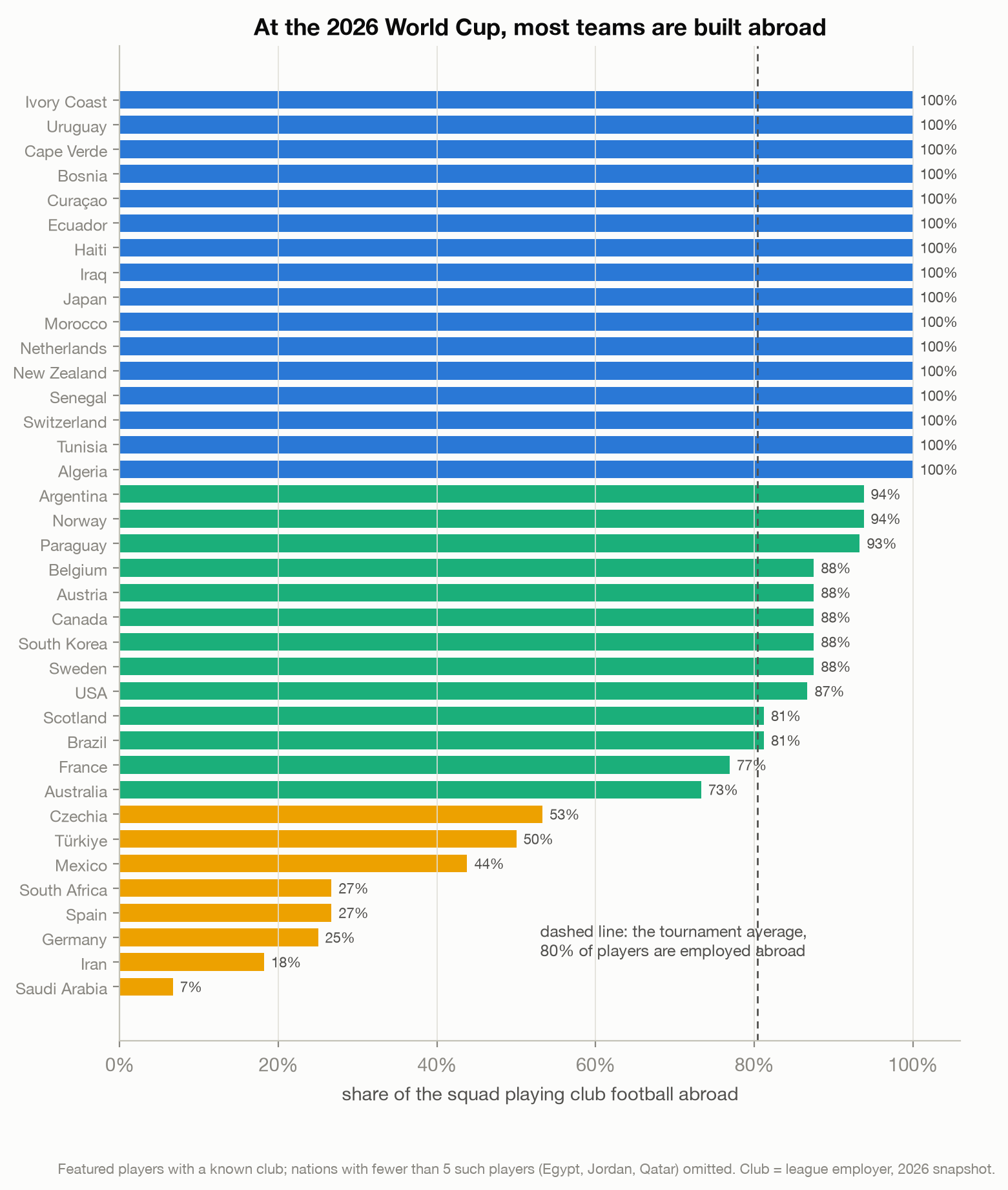
And that average hides how total it gets. Of the thirty-seven nations with enough players to measure, sixteen are built entirely abroad: not one member of the squad who has played earns his living at home. Morocco, Japan, Senegal, the Netherlands, Switzerland, for every one of them, every single player who has taken the field earns his living somewhere else. Morocco’s are scattered across Paris, Madrid, London and Amsterdam. Japan’s play in Germany, Scotland, the Netherlands and England. These are not the weak teams. Morocco reached the semi-finals of the last World Cup built exactly this way.
So when Indonesia assembled a squad of players based in Europe, it was not inventing a loophole. It was doing, through naturalization, what most of the planet’s national teams already do by circumstance. On this measure Indonesia would not have looked strange at the 2026 World Cup. It would have looked like Morocco.
Where “abroad” means Europe
Ask where all these players actually go, and the answer is almost embarrassingly concentrated.
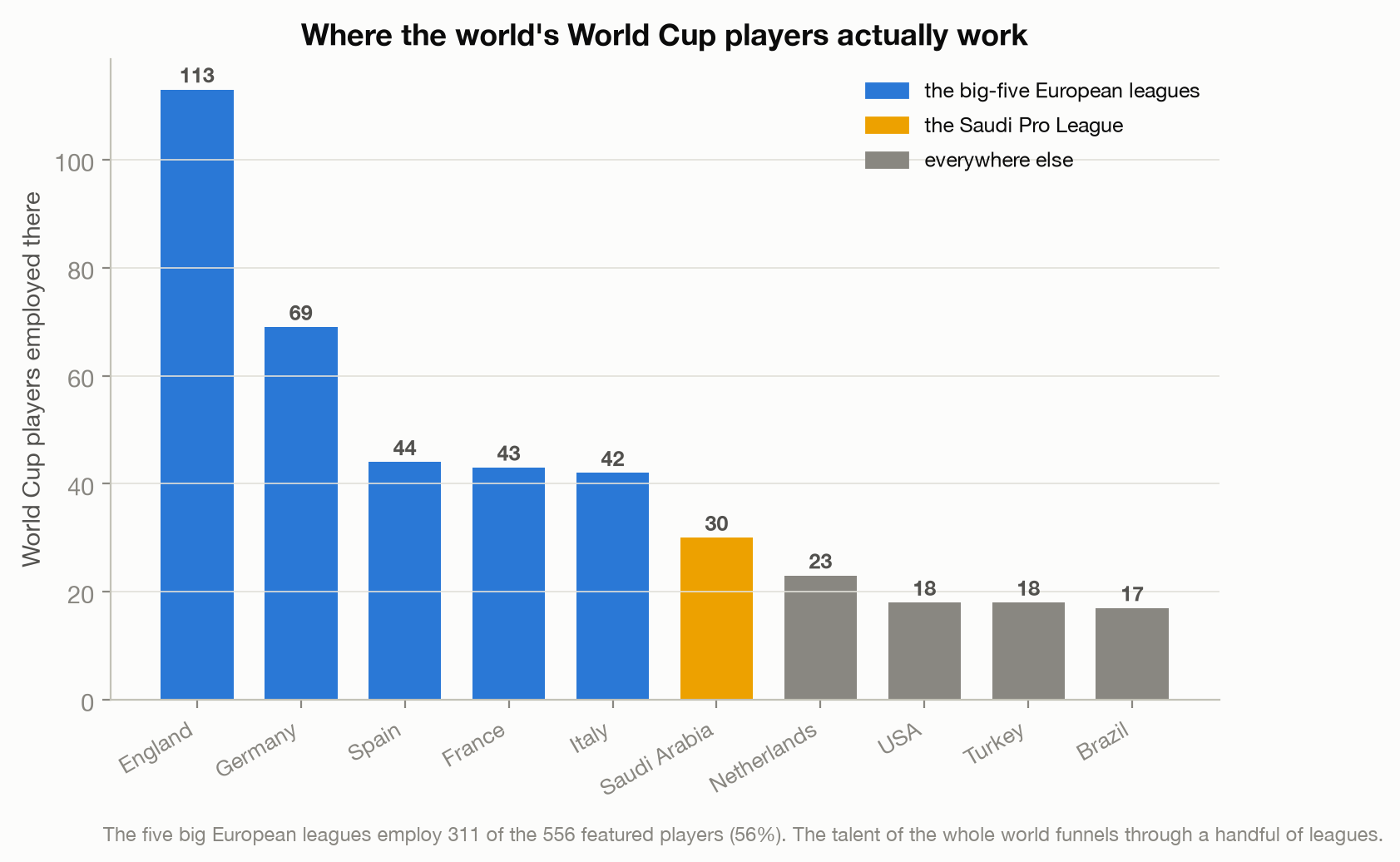
The English leagues alone employ 113 of the featured players, more than any country by a distance. Add Germany, Spain, France and Italy and the big five European leagues account for 311 of the 556 players I could place, about 56% of everyone in this dataset. The talent of the whole world, developed in Rabat and Osaka and Montevideo, funnels through a handful of European leagues, plus a newer, richer entrant in Saudi Arabia. This is not a World Cup surprise; the CIES Football Observatory has tracked football expatriates at a record high, with England the leading importer of them (Poli et al., 2024). The tournament is just the same migration, wearing national shirts for a month.
That is the sense in which nobody builds a team at home anymore. The building happens in a dozen league cities, and the national team is the arrivals hall.
The number that means two opposite things
Here is where I have to be careful, because the tidy finding hides a real problem, and it is the same problem that makes the Indonesia argument so hard to end.
A club tells you where a player is employed. It does not tell you where he was made. And “built abroad” quietly covers two opposite stories.
Look at the Netherlands, at 100% abroad, and Indonesia, which would sit right beside it. The numbers would be nearly identical. The meaning is inverted. The Dutch play abroad because their academies are so good that the Eredivisie cannot hold its best products; Ajax and PSV develop them, and Europe’s giants buy them. That is an export. Indonesia’s foreign-based players were developed by other countries’ systems entirely, and then naturalized. That is an import. One nation grows the talent and loses it. The other never grew it and acquires it. My chart cannot tell them apart, and neither can anyone who waves the “look, everyone plays abroad” statistic at the naturalization debate, including, if I am honest, the version of this essay that stopped one section ago.
The home-based teams make the same point from the other direction.
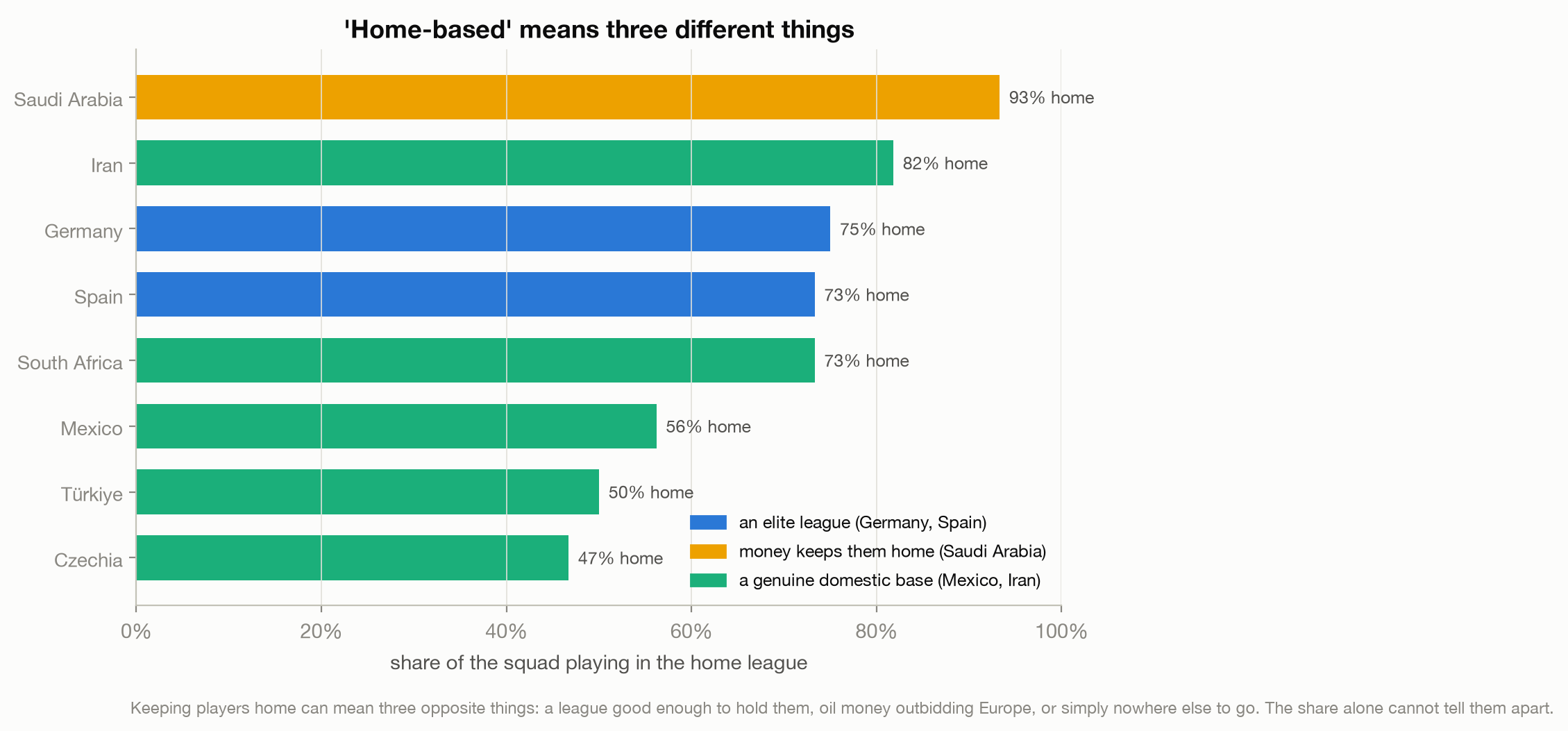
Keeping your players home turns out to mean three completely different things. Saudi Arabia is the most home-based team at the tournament, with 93% in its own league, because the Saudi Pro League now pays enough to keep them and to buy other countries’ stars too. Germany and Spain keep about three-quarters of theirs home because their leagues are among the best on earth. Mexico, Iran and South Africa keep players home for the plainest reason of all, which is that fewer European clubs come calling. Three of those situations look the same in my data and could not be more different in what they say about a football culture. The share alone is silent on which is which.
What Indonesia actually bought
So I will hold the tension rather than resolve it, because the data earns both halves.
The critics of naturalization who say “this is not really our team” are answered by the tournament: almost no one’s team is home-grown anymore, and demanding that Indonesia field only home-league players would be demanding it play by rules no qualifier follows. The reality of modern international football is that you assemble talent wherever it lives.
But the defenders who point at Morocco and say “see, it is the same thing” are answered by the same data, one layer down. Morocco is built abroad because it produces players the world wants. Indonesia bought its way to the edge of that world with passports. Those are not the same achievement, even when they produce the same chart. Naturalization got Indonesia a seat at the reality every serious footballing nation lives in. It did not build the academies that would let the country stay there once the imported generation ages out. It bought presence. Presence is not a pipeline.
That is the honest verdict, and it is less satisfying than either side wants. Indonesia was right that this is how the game works now, and its skeptics were right that working the system is not the same as building something. A World Cup team assembled abroad is a destination. The question that decides whether Indonesia is ever more than a near-miss is the one my data cannot see: who, ten years from now, will have grown at home.
Method notes
Data: Kaggle “FIFA match, player and team dataset 2026” (wasiqaliyasir, 2026), an early snapshot created 2026-06-19 covering 20 matches, 40 of the 48 qualified national teams and 1,035 squad players. A player is counted as foreign-based (“abroad”) when the country of his club’s league differs from the country he represents; I use the league’s country, so a Monaco player counts as France and an Auckland FC player as Australia. Each of the 234 distinct clubs among featured players was mapped to a league country by hand and checked. The share is computed over players who have featured and whose club is recorded (556 of 627), which skews toward players good enough to play, and since the best players are both likelier to move abroad and likelier to feature, that probably nudges the 80% figure a little high; three nations with fewer than five such players (Egypt, Jordan, Qatar) are omitted from the ranking. National-team country names were reconciled to club-country names (for example United States to USA, Korea Republic to South Korea). One deliberate strength of this dataset: squad composition is fully observed even though the 20-match performance statistics are far too thin to judge anyone on, so the argument here rests on who was picked and where they work, not on early results. Caveats: club is employment, not development, and cannot distinguish home-grown-and-exported from imported-and-naturalized; the snapshot may miss late squad changes; and Indonesia is not in the dataset, so every statement about Indonesia is context, not a measurement. Code and the club-to-country mapping are on GitHub: github.com/joechrisnaldy/data-stories.
References
Hand, K. (2025, October 16). Indonesia and Kluivert part ways after FIFA World Cup 2026 miss. Al Jazeera. https://www.aljazeera.com/sports/2025/10/16/indonesia-and-kluivert-part-ways-after-fifa-world-cup-2026-miss
Poli, R., Ravenel, L., & Besson, R. (2024). Football expatriates [Monthly report]. CIES Football Observatory. https://football-observatory.com
wasiqaliyasir. (2026). FIFA match, player and team dataset 2026 [Data set]. Kaggle. https://www.kaggle.com/datasets/wasiqaliyasir/fifa-match-player-and-team-dataset-2026
// About the author
Jonathan Chrisnaldy is a product manager and analyst in New York City, with an M.S. in Technology Management from Columbia University. He writes data stories about the numbers behind everyday claims. More on the experience page or LinkedIn.