· 8 min read · Jonathan Chrisnaldy
Everyone Says Substance. Everyone Picks Chemistry.
Speed daters rank intelligence at the top of what they want in a partner. Minutes later, they hand out 'yes' on the basis of something else entirely. The list of what we want is mostly a wish; the choosing is the tell, and it turns out to be the same tell for men and women.
What a person actually wants in a partner is not in the list they would give you. It is in who they pick. Ask anyone and you get the list: kind, smart, ambitious, funny. It is sincere, and it is mostly aspiration. Thanks to an old experiment, we can watch people produce both, the list and the pick, minutes apart.
Between 2002 and 2004, researchers at Columbia ran a speed dating study: 21 rounds, hundreds of graduate students, four minutes a date (Fisman et al., 2006). Before the night began, each person divided 100 points across six traits to say what they were looking for. Then they met a dozen strangers, rated each one, and checked yes or no. So for every dater we have two numbers on the same six traits: what they said mattered, and what actually moved them to a yes. The gap between those two is the whole essay.
What people say
Start with what people say, because the cliche survives it.
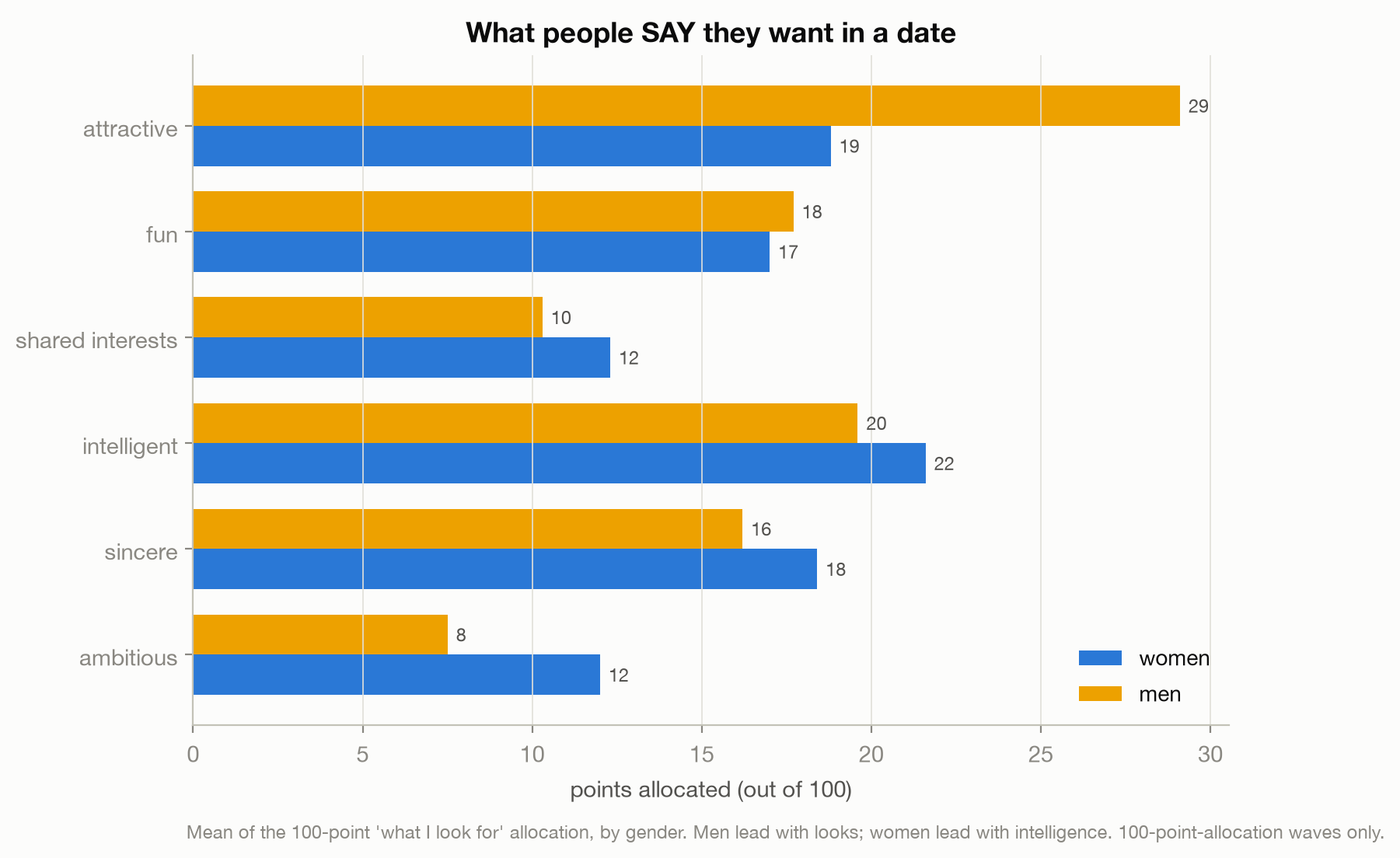
Men put 29 of their 100 points on attractiveness, more than any other trait by a wide margin. Women spread their points out and put the most, almost 22, on intelligence. Women also rated ambition more highly than men did, 12 points to 7.5. If you only read the wishlists, you would conclude that men want a face and women want a mind, and maybe a career. This is exactly the story everyone already believes, which is the first reason to be suspicious of it.
What actually earns a yes
Now watch the choosing. For each trait, I measured how strongly a person’s rating of a date predicted whether they said yes to them.
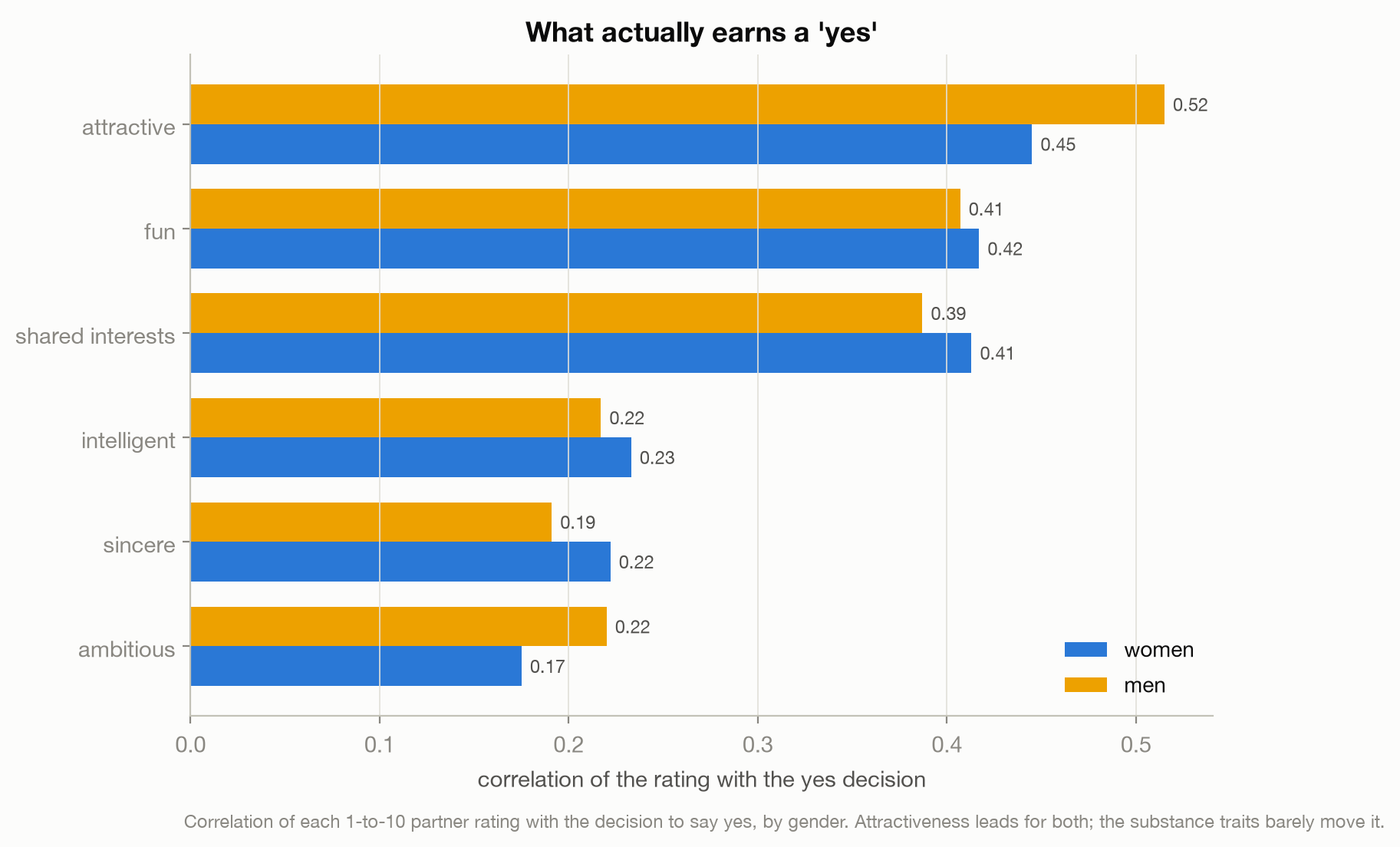
For both men and women, one trait wins, and it is the same trait. Attractiveness: a correlation of 0.52 for men, 0.45 for women. For men that is far ahead of everything else; for women it only edges out fun and shared interests, which sit almost level with it. Those two, fun and shared interests, are the things we might loosely call chemistry, and they pull hard for both sexes. Intelligence, meanwhile, the trait women put first and men put second on their lists, sits near the bottom of what actually earned a yes, at roughly half the pull of attractiveness. Whatever people said beforehand, they decided on looks and chemistry.
Two smaller things worth noticing before I overstate the symmetry. Women were pickier, saying yes 37% of the time to men’s 47%, but they were picky along the same axis, not a different one. And ambition, the trait women claimed to value more than men, actually predicted men’s choices a little more than women’s (0.22 to 0.17). The one place the cliche promised women would reward substance most, they did not reward it more, though that gap is small enough that I would not lean on it.
The list is upside down
When I lay the saying and the doing side by side, the reversal is hard to miss.
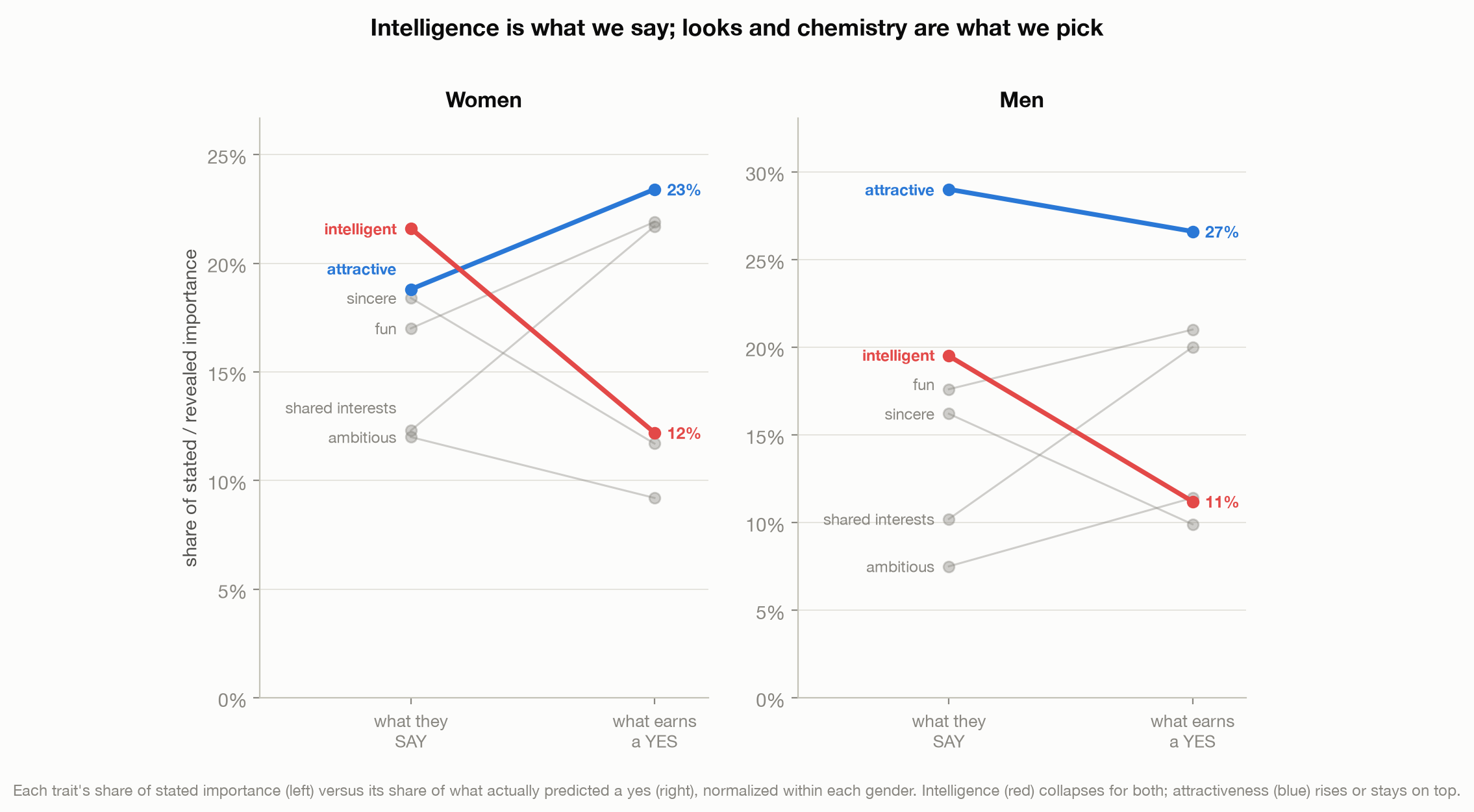
Intelligence, which women ranked first and men ranked second, falls to fourth and fifth once you look at their actual choices. Everyone overstates it. Attractiveness does the opposite: for women it climbs to the top, and for men, who already led with it, it simply stays there. Fun and shared interests climb for both. For women the list is close to upside down; for men the top holds and the reshuffle happens underneath it.
Here is the asymmetry, and it is the honest heart of this, so let me be careful with it. Both sexes overstate substance: intelligence is the first or second thing each says it wants, and for each it lands fourth or fifth in what they pick. The difference is only in the headline. The trait men lead with, attractiveness, is also the one that wins, so men are candid, almost blunt, and it is not that women are any less honest. It is that the script hands the two sexes different lines to read. Men are allowed to say out loud that they are choosing on looks; women are expected to say they are choosing on a mind, and then they choose the way the whole room does, men included. The performance is gendered not because women perform more, but because the thing women are told to want, a mind, is the thing the data most flatly contradicts, while the thing men are allowed to want, a face, is the thing it confirms.
I want to be careful about that word, performing, because the data cannot quite prove it, and there are at least three ways to read the gap. One is performing for other people. One is simply not knowing yourself; a person can misjudge their own future behavior without lying about it. And one is the clock. A four-minute date rewards whatever is legible in four minutes, a face, a laugh, an easy back-and-forth, and gives intelligence and sincerity almost no room to show up. So intelligence may not fall because people secretly do not care about it; it may fall because you cannot read it across a small table in the time it takes to order a drink. This experiment shows the gap. It cannot tell you how much is social costume, how much is honest self-ignorance, and how much is just the format. Probably all three. And a hard fence around it: these were Columbia graduate students around 2003, in a binary, opposite-sex-only setup with that four-minute clock. This is a fact about them, then, not a law of attraction, and not a verdict on who anyone should want.
The list and the choice are different documents
Still, the shape of it travels. In Indonesia, the wishlist is practically an institution: the biodata traded before a ta’aruf, the old family arithmetic of bibit, bebet, bobot, the checklist for a mapan, settled and providing, husband. We treat these lists as if they were the preference itself. This small experiment from a different country and a different decade is a quiet warning that the list and the choice are two different documents, and that when they disagree, the choice is the one that is harder to fake.
That is the part that reaches past dating. Every time we ask people what they want, in a survey, a customer interview, a job description, a form, we get the list: the considered, presentable, faintly aspirational version of a person. What they actually do when a real option is in front of them is often something else. The list is who we think we ought to be. The choice is who we are in the moment, which is not the whole of what we want but is the part that actually moves. When the two disagree, and they usually do, these daters quietly trusted the second one. Most of the time, so should we.
Method notes
Data: the Columbia speed dating experiment (Fisman et al., 2006), redistributed on Kaggle (annavictoria), 8,378 date-level rows from 551 subjects across 21 waves. Gender is recorded as a binary (female, male) and the matching is opposite-sex only; this piece is limited by that design and makes no claim beyond it. “What people say” is the mean of the 100-point “what I look for” allocation across the six traits, computed only on the waves that used the 100-point allocation (waves 6 to 9 used a 1-to-10 importance scale and are excluded from the stated figures). “What earns a yes” is the correlation of each 1-to-10 partner rating with the yes decision, computed separately by gender; it is a descriptive association, not a causal weight, and a logistic model gives the same ordering. The third chart normalizes each side to a share of importance within each gender so the two can be compared on one axis. Caveats: correlation is not causation; the sample is a specific population at a specific time; and the gap between stated and revealed preference has at least three explanations (social performance, plain self-ignorance, and the four-minute format itself) that this data cannot separate. Code is on GitHub: github.com/joechrisnaldy/data-stories.
References
Fisman, R., Iyengar, S. S., Kamenica, E., & Simonson, I. (2006). Gender differences in mate selection: Evidence from a speed dating experiment. The Quarterly Journal of Economics, 121(2), 673-697. https://doi.org/10.1162/qjec.2006.121.2.673
annavictoria. (2016). Speed dating experiment [Data set]. Kaggle. https://www.kaggle.com/datasets/annavictoria/speed-dating-experiment
// About the author
Jonathan Chrisnaldy is a product manager and analyst in New York City, with an M.S. in Technology Management from Columbia University. He writes data stories about the numbers behind everyday claims. More on the experience page or LinkedIn.