· 11 min read · Jonathan Chrisnaldy
Everyone Knows Social Media Is Wrecking Teens. The Evidence Doesn't.
We have already reached a verdict: social media is wrecking teenagers. It is a bestseller, a Surgeon General warning, a wave of school phone bans. But the evidence under all that certainty is surprisingly thin, and we cannot even measure the thing we are so sure about.
The verdict is in, and it was in before most of us read a single study. Social media is wrecking a generation of teenagers. You know this the way you know the sky is up. It is the premise of a bestselling book, Jonathan Haidt’s The Anxious Generation. It is the reason schools across the country are locking phones in pouches, and the reason governments are writing age limits into law. In 2023 the US Surgeon General issued a formal advisory on social media and youth mental health, the kind of document reserved for cigarettes and loneliness epidemics.
So the strange part is what happens when you actually open the evidence. Not the headlines about the evidence, the evidence. It is thinner, smaller, and shakier than the confidence built on top of it. This is not an argument that social media is harmless. It is an argument that we reached a verdict we have not earned, and that being this certain about something we can barely measure is its own kind of risk.
Everyone is sure, mostly about other people’s kids
Start with the certainty itself, because it has a tell. In its 2025 report, Pew Research Center found that 48% of US teenagers said social media has a mostly negative effect on people their age, up from 32% three years earlier. Half of teens will tell you the platforms are bad for teenagers. But when Pew asked those same teens whether social media negatively affects them, personally, only 14% said yes.
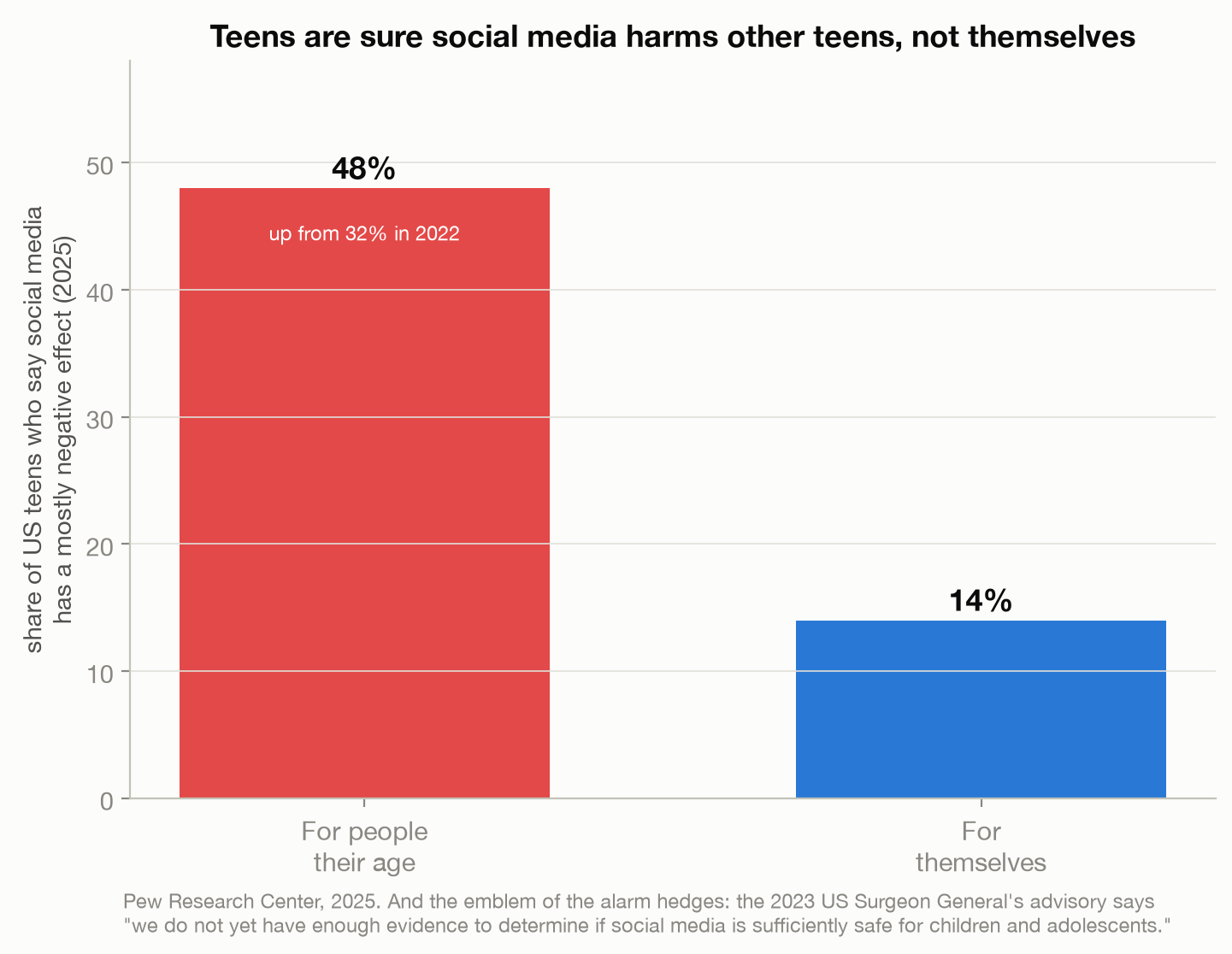
That gap is worth sitting with. It is the shape of a moral panic: a thing that is always happening to other people’s children. Everyone can see the harm in the abstract and struggles to find it in the specific teenager they actually are or know.
And the most authoritative voice in the American debate is more careful than its reputation. The Surgeon General’s 2023 advisory is often cited as proof that the science is settled. Read it, and it says the opposite. In its own words, “we do not yet have enough evidence to determine if social media is sufficiently safe for children and adolescents” (Office of the U.S. Surgeon General, 2023). It flags potential risk, it calls for more research, and it devotes a section to the questions that remain unanswered. The document everyone treats as a guilty verdict is, on the page, a call for evidence we do not have.
The distress is real
Here is where honesty cuts the other way, because something real did happen. The share of American high school students who report persistent feelings of sadness or hopelessness, feeling so sad or hopeless almost every day for two weeks that they stopped doing usual activities, climbed from 28.5% in 2011 to 42.3% in 2021, according to the CDC’s Youth Risk Behavior Survey (Centers for Disease Control and Prevention, 2024).
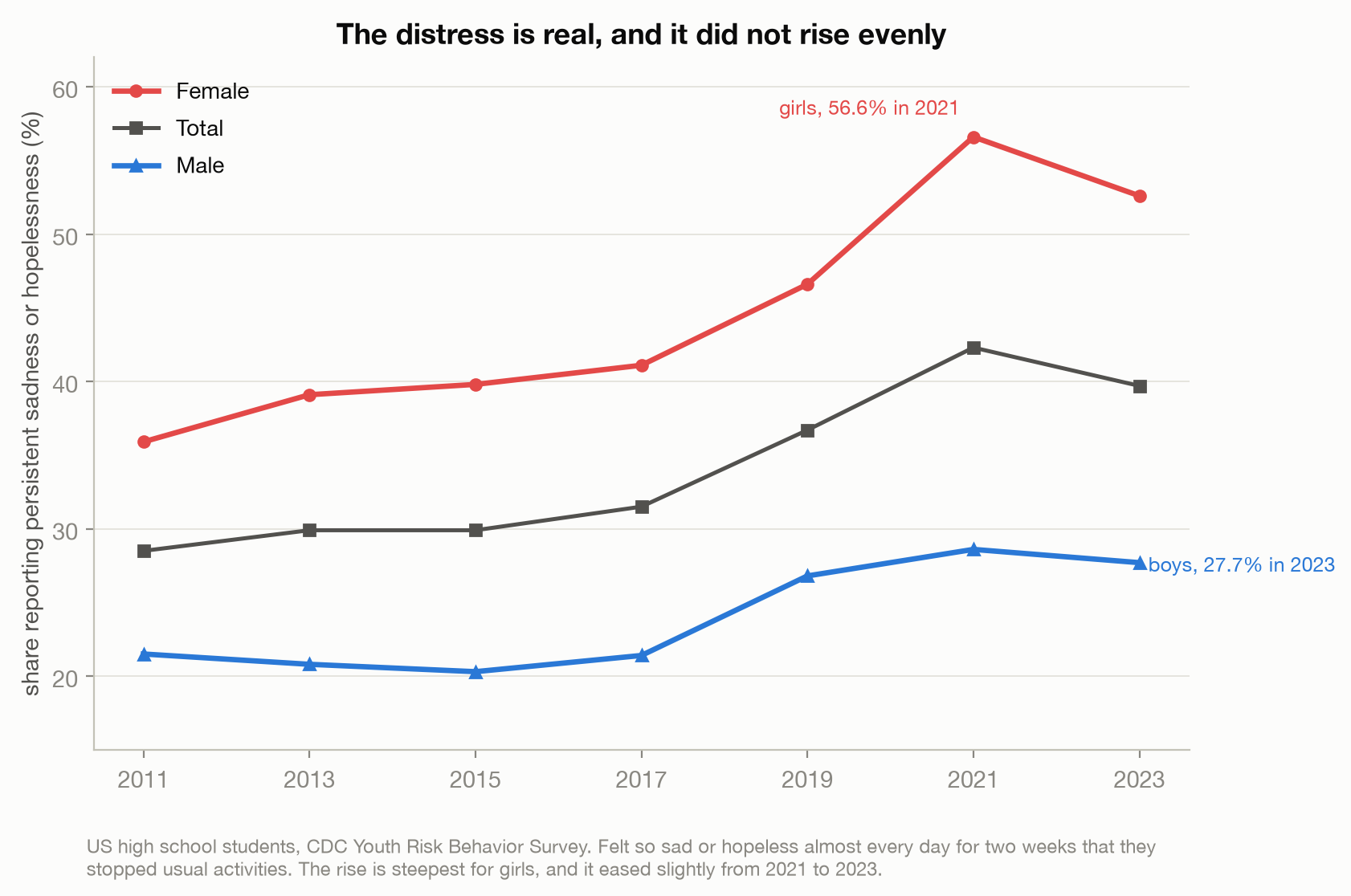
The rise was not evenly shared. For girls it went from 35.9% to 56.6%, so that by 2021 more than half of teenage girls were reporting this. For boys it moved far less, from 21.5% to 28.6%. Anyone who tells you nothing is wrong with teenagers is not looking at this line. Two things complicate the simple story, though. The number eased slightly in 2023, to 39.7% overall, which a smooth tale of ever-worsening ruin does not predict. And a trend line, however steep, cannot tell you why it moved. The same years brought a financial crisis hangover, opioids, school shootings, changing survey norms about naming distress, and, yes, smartphones. The rise is the reason the question matters. It is not the answer to it.
Measured carefully, the effect is potato-sized
So researchers tried to measure the link directly, and this is where the certainty quietly collapses. In 2019 Amy Orben and Andrew Przybylski took the large datasets everyone cites, including the very CDC survey above, and did something unusual. Instead of running one analysis and publishing it, they mapped out every defensible way to run it, hundreds of millions of possible specifications across the datasets, and then ran a vast number of them, to see how much the answer depended on the choices the researcher makes (Orben & Przybylski, 2019).
The answer was that digital technology use explains, at most, about 0.4% of the variation in adolescent well-being. To make that number legible they compared it to other things measured in the same surveys.
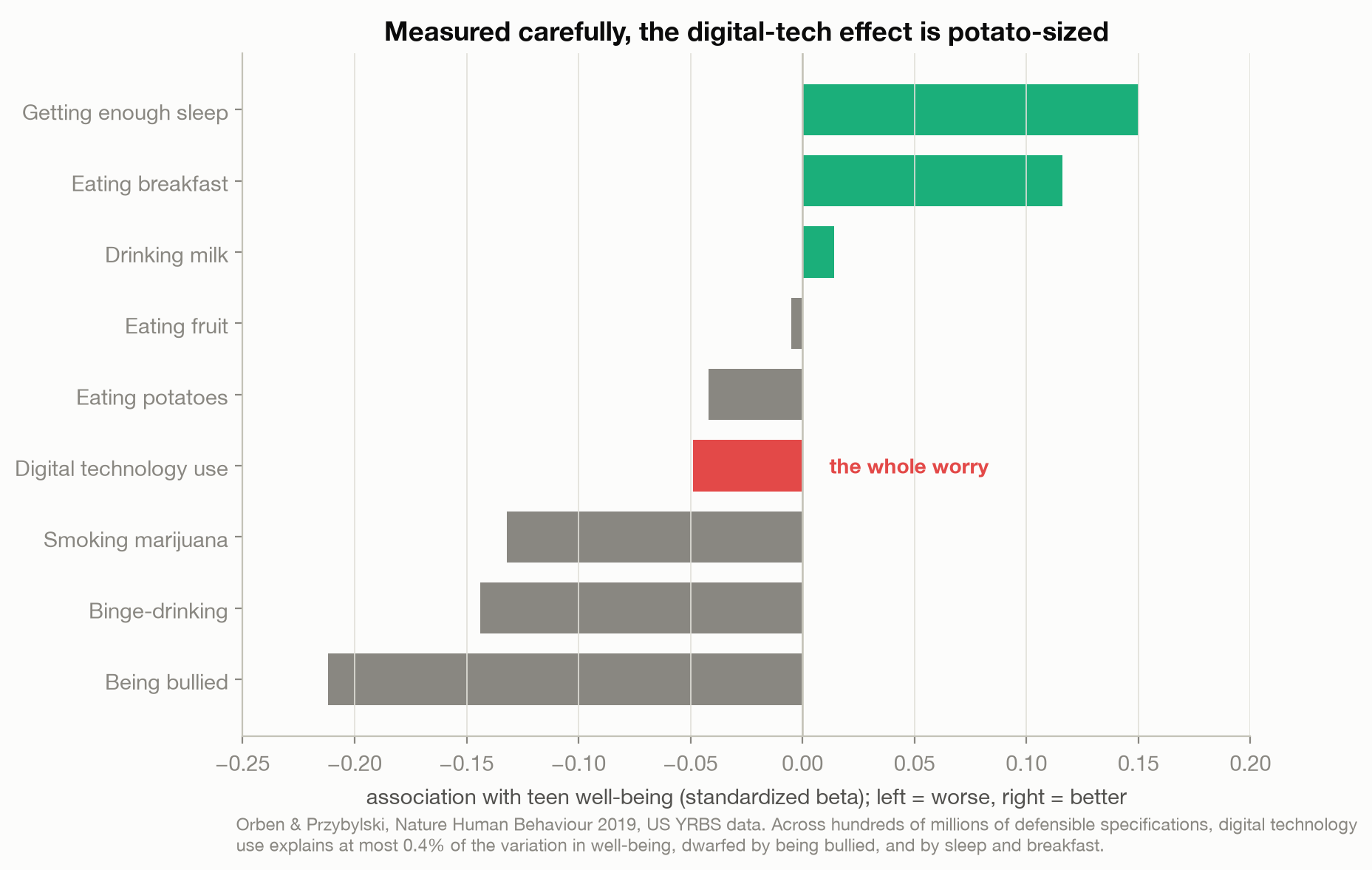
Using the US data, digital technology use was associated with well-being about as strongly as eating potatoes, and slightly less than wearing glasses. It was dwarfed by things nobody markets a panic around: being bullied was several times worse, and getting enough sleep or eating breakfast were two to three times better in the other direction. One honest caveat, which I want to state plainly rather than bury: Orben and Przybylski measured “digital technology use” broadly, not social media alone. Social media is the piece of that bucket the public fears most. But even the whole category, screens and all, comes out potato-sized.
And we can’t even measure the cause
There is a deeper problem underneath all of this, and it is almost funny once you see it. The entire debate turns on how much time teenagers spend on social media. We do not know how much time teenagers spend on social media.
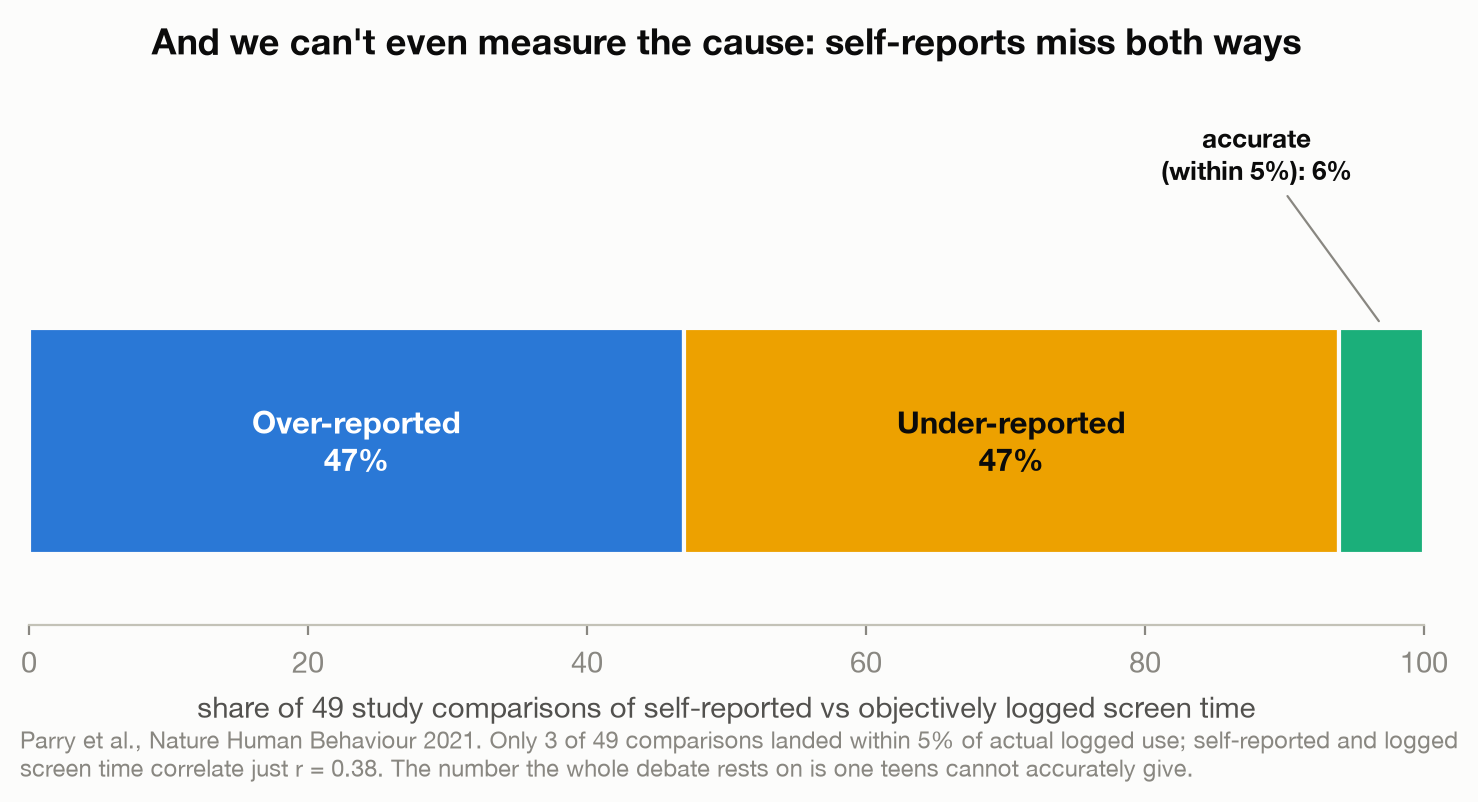
In 2021 a team led by Douglas Parry gathered every study they could find that compared what people said about their screen time against what devices actually logged. Across the studies, self-reported and logged use correlated at just r = 0.38, a moderate link, far from the near-match you would need to trust a teenager’s estimate of their own hours. Of 49 comparisons, only three, about 6%, landed within 5% of the real logged figure (Parry et al., 2021). And the errors did not even point one way. Roughly equal numbers of studies over-reported and under-reported their use, so you cannot simply “adjust” for a known bias. The ruler is not just short, it is bent in a different direction for each person holding it. Most of the studies that built our certainty asked teenagers to estimate a number they cannot estimate, and then correlated that guess with a mood score.
We can’t know yet
Put the four together and the picture is not “social media is fine.” It is something more uncomfortable. Teen distress genuinely rose. The measured effect of digital life on that distress, when measured carefully, is tiny and unstable. And the core input to those measurements is a number teenagers cannot accurately give. That is not a foundation for certainty in either direction. It is a foundation for saying we do not know yet, and meaning it.
That answer is unsatisfying, which is exactly why we avoid it. A generation getting sadder is frightening, and fear wants a single, fixable cause. Social media is the perfect villain: new, ambient, made by disliked companies, and held in the hand of every anxious kid. Blaming it feels like doing something. But the same certainty that comforts us also has costs. It writes laws, reorganizes schools, and tells millions of teenagers that the ordinary texture of their social lives is a pathology, all on evidence that its own flagship advisory calls insufficient.
None of this says: hand your thirteen-year-old a phone and look away. Careful is careful. Sleep, which the same data shows actually matters, is worth protecting from a device that eats it. But there is a difference between reasonable caution and a settled verdict, and we have been selling the second while holding only the first. The honest position, the one that respects both the real pain in that CDC line and the real thinness of the evidence, is to hold the question open. We decided this case before the evidence was in. The grown-up move is to admit the trial is still going. This is an analysis of published research, not medical advice.
Method notes
Four real sources, each figure verified against the primary document (exact quotes on file). Pillar one: Pew Research Center (2025), US teens saying social media has a “mostly negative” effect on people their age (48%, up from 32% in 2022) versus on themselves (14%); plus the U.S. Surgeon General’s Advisory (2023). Pillar two: CDC Youth Risk Behavior Survey, persistent feelings of sadness or hopelessness among US high school students, question H26, 2011 to 2023, overall and by sex (2023 values confirmed against CDC MMWR su7304a9); Total 28.5% (2011), 42.3% (2021), 39.7% (2023); Female 35.9%, 56.6%, 52.6%; Male 21.5%, 28.6%, 27.7%. Pillar three: Orben and Przybylski (2019), specification curve analysis; digital technology use explains at most 0.4% of well-being variance (reported as partial eta-squared); the comparison bars all use the US YRBS dataset so they are like-for-like (digital technology use beta -0.049, eating potatoes -0.042, being bullied -0.212, getting enough sleep +0.150, eating breakfast +0.116); “wearing glasses” (-0.061) is a UK-survey anchor, noted but not charted; the “hundreds of millions” refers to specifications identified, of which a tractable subset was run. Pillar four: Parry et al. (2021), meta-analysis; self-reported versus logged media use correlate at r = 0.38 (general use) and r = 0.25 (problematic use); 3 of 49 comparisons within 5% of logged use; over- and under-reporting equally common, so no statistically supported systematic direction of bias. Everything here is associational; correlations and published effect sizes are not causes. A synthetic Kaggle dataset on this topic was reviewed and rejected as unusable: most of its rows were dated to future years, out to 2060, and its outcomes were formula-generated. Code and data are on GitHub: github.com/joechrisnaldy/data-stories.
References
Centers for Disease Control and Prevention. (2024). YRBS Explorer: National high school Youth Risk Behavior Survey, persistent feelings of sadness or hopelessness, 2011-2023 [Data tool]. U.S. Department of Health and Human Services. https://yrbs-explorer.services.cdc.gov/
Haidt, J. (2024). The anxious generation: How the great rewiring of childhood is causing an epidemic of mental illness. Penguin Press.
Office of the U.S. Surgeon General. (2023). Social media and youth mental health: The U.S. Surgeon General’s advisory. U.S. Department of Health and Human Services. https://www.hhs.gov/sites/default/files/sg-youth-mental-health-social-media-advisory.pdf
Orben, A., & Przybylski, A. K. (2019). The association between adolescent well-being and digital technology use. Nature Human Behaviour, 3(2), 173-182. https://doi.org/10.1038/s41562-018-0506-1
Parry, D. A., Davidson, B. I., Sewall, C. J. R., Fisher, J. T., Mieczkowski, H., & Quintana, D. S. (2021). A systematic review and meta-analysis of discrepancies between logged and self-reported digital media use. Nature Human Behaviour, 5(11), 1535-1547. https://doi.org/10.1038/s41562-021-01117-5
Pew Research Center. (2025, April 22). Social media and teens’ mental health: What teens and their parents say. https://www.pewresearch.org/internet/2025/04/22/teens-social-media-and-mental-health/
Verlenden, J. V., Fodeman, A., Wilkins, N., Everett Jones, S., Moore, S., Cornett, K., Sims, V., Saelee, R., & Brener, N. D. (2024). Mental health and suicide risk among high school students and protective factors: Youth Risk Behavior Survey, United States, 2023. MMWR Supplements, 73(4). https://www.cdc.gov/mmwr/volumes/73/su/su7304a9.htm
// About the author
Jonathan Chrisnaldy is a product manager and analyst in New York City, with an M.S. in Technology Management from Columbia University. He writes data stories about the numbers behind everyday claims. More on the experience page or LinkedIn.